Which Property Valuation Do I Need in the Netherlands?
A practical guide to choosing between a physical, hybrid, model-based or WOZ valuation for a mortgage, purchase, renovation, sale or another purpose.

TL;DR: match the option to the purpose
Choose the valuation by starting with the decision it must support. A lender may need a validated report. A buyer may need evidence for financing. A seller may want a reasoned view of market value before discussing an asking price. A municipality’s WOZ value serves a statutory purpose and is not a universal substitute for another valuation.
If you are choosing a valuation type, compare the assignment’s purpose with local context such as property valuation in Taxatie Bij Scheiding, Amsterdam; location alone does not decide the report format.
Before you compare fees, ask each provider about property valuer selection for your property and report recipient.
Before you act on a figure, separate a free estimate and a formal valuation by purpose, evidence and intended use.
If your question concerns tax or WOZ, keep the tax rule and WOZ and market value explanation as separate parts of the assessment.
The main options are:
- Physical valuation: a valuer visits the home, inspects it and prepares a report for a defined assignment.
- Hybrid valuation: a model and property information are combined with a remote review by a valuer. NHG allows this in defined situations and with conditions.
- Model-based valuation: a model calculates an indication from property and market information without the same physical visit.
- WOZ value: the municipality determines an annual value for tax and levy purposes at a stated valuation date.
Ask the recipient which document it accepts before comparing fees. The cheapest option is a poor choice when it cannot answer the receiving organisation’s question.
If you are unsure whether you need a report, connect when you need a property valuation with the decision in front of you.
When the report arrives, compare its purpose, date and evidence with reading a valuation report.
Does this situation match your question?
If you are a homeowner, buyer, seller, adviser or landlord who has been told to arrange a valuation and is unsure which product fits. It is also useful when several providers use different names for similar services.
If you have not chosen a provider yet, match property appraiser choice to your property, purpose and report recipient.
If you are buying an apartment, match apartment property valuation to the unit, VvE documents and lender requirements.
You do not need to know every technical term before making the first call. You do need four facts: the purpose, the organisation receiving the result, the date that matters and any property feature that could change the investigation.
If the question concerns insurance, keep property valuation for insurance separate from market value and WOZ value.
Why the purpose changes the valuation
“What is the home worth?” is too broad to choose a report. A mortgage application asks whether the property value supports lending under the lender’s rules. A renovation decision may focus on value before and after works. A sale conversation may need a market view and a pricing discussion. A division of assets may require a documented value at a defined date.
If the home has been renovated, record property valuation after renovation with the completed work, plans and supporting documents.
NHG explains that a property valuation is used to establish market value for mortgage purposes. Its guidance distinguishes physical, model-based and hybrid approaches. The current NHG rules can set different limits and conditions for those approaches, so the same home can need a different option for a different decision.
If you need a mortgage report, match mortgage valuation to the lender’s requirements before you book an inspection.
Start with the report recipient’s rules
Before contacting a valuer, ask the lender, adviser, solicitor, court, tax professional or other recipient:
- Which report format is accepted?
- Is validation by an accepted organisation required?
- How recent must the valuation date be?
- Must the valuer meet a registration or independence requirement?
- Does the property have a feature that needs extra evidence?
Before you book an inspection, ask the lender which valuation report the lender accepts fits your application. A NWWI validated report is part of a defined process, while a free indication or model value can serve a different purpose.
What each valuation option can support
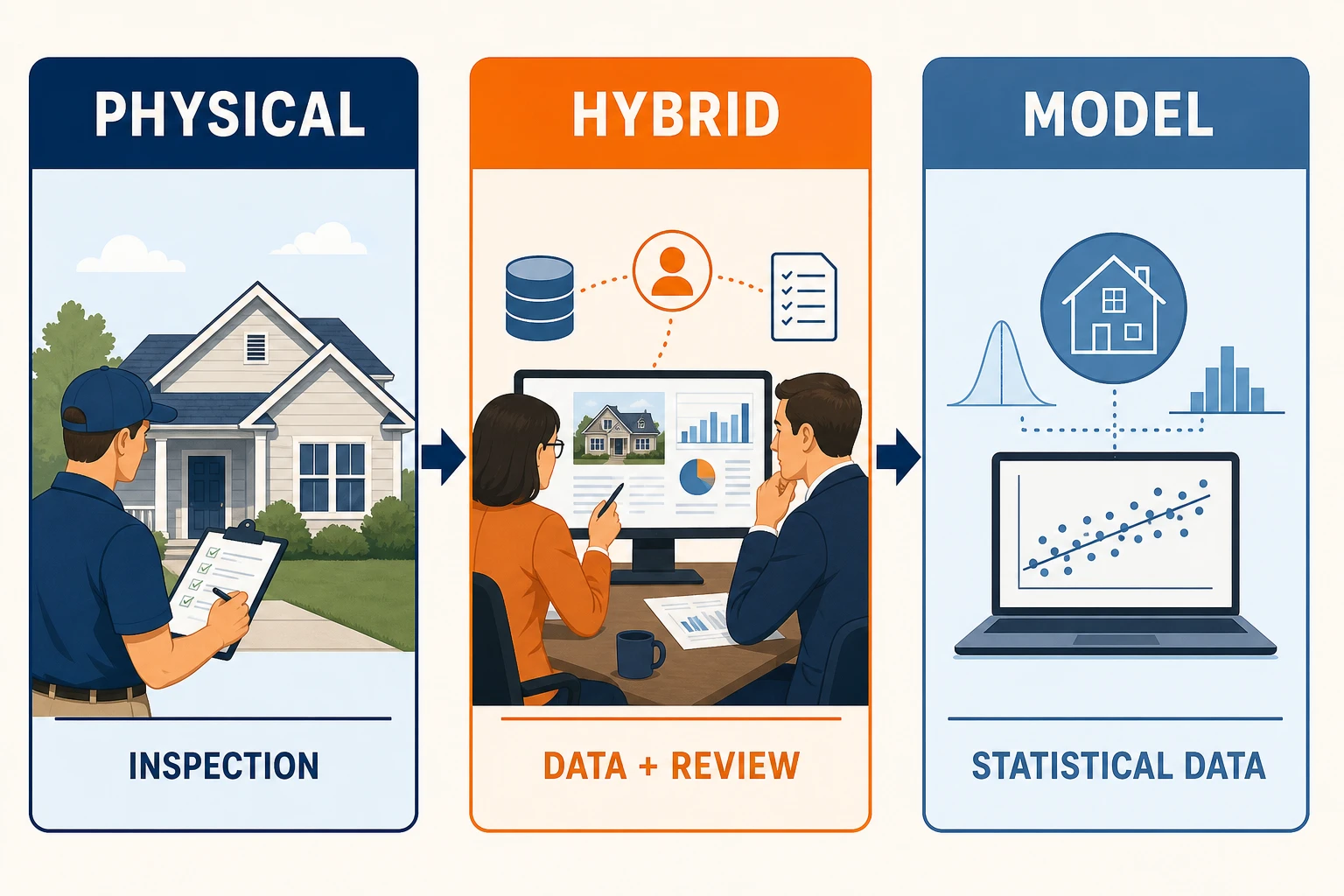
The visual below separates the three main report options by the evidence used. It is a decision aid, not a promise that a lender will accept one option in every case.
If your question concerns tax or WOZ, keep the tax rule and property valuation for tax purposes as separate parts of the assessment.
Physical valuation
A physical valuation is the clearest fit when the assignment needs an on-site inspection or when the lender’s conditions require one. The report records the property, relevant documents, valuation date, value basis, comparable evidence and reasoning. A valuation is not the same as a full building survey, so a technical inspection may still be needed for hidden defects.
Before you compare fees, ask each provider about property valuer selection criteria for your property and report recipient.
Hybrid valuation
A hybrid valuation uses property and market information with a valuer’s remote review. NHG describes approved situations in which this option can be used. Under current NHG information, a hybrid valuation can have a loan limit of no more than 90% of the market value determined by that valuation. A lender can impose its own conditions.
Model-based valuation
A model-based result is built from data and statistical relationships. It can be useful for an early estimate or for a process that explicitly accepts it. It has less ability to examine a renovation, unusual layout, poor maintenance or a feature that is missing from a database.
WOZ value
The municipality sets the WOZ value for a stated date and public-law purposes.
It can be useful evidence in a conversation, yet its purpose differs from a report prepared for a mortgage, sale assignment or private division.
How to choose in five steps
1. Write down the decision
Use one sentence: “I need this value to ___, and ___ will receive it.” This prevents a general estimate from being ordered for a formal process.
2. Confirm the document
Ask for the accepted format, validation, age and valuation date in writing. Keep the reply with your mortgage or transaction file.
3. Flag property conditions
Mention renovation, leasehold, letting, an apartment structure, a split title, unusual outbuildings or a recent change. The valuer can then tell you whether extra work or a physical visit is needed.
4. Compare like with like
Give each provider the same purpose, documents and target date.
Ask who performs the work, which costs are included, what validation costs and what can delay delivery.
5. Check the final report
When the report arrives, check the address, ownership details, valuation date, purpose, value basis, assumptions and recipient requirements.
Four common situations
You are buying a home with a mortgage
Ask the lender first. A physical or approved hybrid option may fit, depending on the loan and current rules. A free estimate is useful for early planning, yet it usually cannot replace the evidence requested for mortgage underwriting.
You are planning renovation
Explain whether the lender needs a value before works, after works or both.
Give the valuer the plans, cost estimate and permits that exist.
You are preparing to sell
An estate-agent indication can help with an initial price conversation. A formal valuation can suit a separate purpose such as a division, inheritance or financing question. Do not assume that one document answers both questions.
You received a WOZ notice
Use the WOZ amount for the purpose for which it was set. If a lender, court or other recipient wants a different report, ask that recipient before ordering anything.
Mistakes that cause delay or rejection
- Booking a report before asking the lender what it accepts.
- Comparing a free indication with a validated report as though they were the same product.
- Failing to mention an apartment, leasehold, renovation or unusual legal situation.
- Assuming the valuation date can be changed after the report is delivered.
- Treating a model result as proof of condition or hidden defects.
- Ordering from a provider without confirming the total fee, validation and delivery time.
If a report is rejected, request the reason in writing. It may be a format, date, validation or independence issue rather than a disagreement about the amount.
Keep the decision current
Valuation rules and lender policies can change. Recheck the recipient’s requirement if the application is delayed, the property changes or the report becomes older than the accepted period. Do not change the published date on an article or report merely because you revisited the information; update dates should reflect a material change to the content or assignment.
Frequently asked questions
Which valuation is best for a mortgage?
The lender decides. A fully reported physical valuation or an approved hybrid valuation may fit an NHG-backed process, subject to current conditions. Ask the lender for the accepted format before you order.
Is a hybrid valuation always cheaper?
It can have a different fee because the process differs from a physical visit. Price is only one factor. Check acceptance, the loan limit, property conditions and delivery requirements first.
Can a WOZ value replace a valuation report?
Only when the receiving organisation expressly accepts it for that purpose. A WOZ value has a municipal purpose and date. It is not automatically interchangeable with a mortgage or sale valuation.
Do I need a physical visit for an apartment?
Ask the recipient and the valuer.
Apartment information from the VvE, maintenance plans and comparable sales can affect the assignment.
Is a valuation the same as a building inspection?
No. A valuation examines the property for its defined value assignment. A building inspection focuses on technical condition and defects. You may need both.
Questions to take to a valuer or lender
Take this short checklist to the conversation:
- What is the exact purpose and who receives the report?
- Which option and validation are accepted?
- Which valuation date is required?
- What documents should I supply?
- What property features could add work or time?
- What is included in the quoted fee?
Beste Taxateur helps you organise the questions and evidence around which property valuation do I need, so you can compare providers and prepare the next step. The relevant lender, adviser, municipality or other party decides which report or evidence it accepts.
Ask a question about which property valuation do I need