Property Valuation Before Buying a Home in the Netherlands
What buyers should check before ordering a property valuation, including lender requirements, report acceptance, documents, timing and hybrid options.

TL;DR: ask the lender before you book
Before buying a home, ask the lender or mortgage adviser which valuation report it accepts. Confirm the format, validation, valuation date, age limit, valuer requirements and any loan-to-value condition. Then give every provider the same assignment so the quotes can be compared.
If you are using bridging finance, match the sale, loan and timing assumptions before you request a property valuation for bridging finance.
Before you make an offer, compare local evidence such as property valuation in Beste Taxateur Inzuid, Amsterdam with the lender’s report requirements and the property’s own condition.
As you prepare for a valuation, gather documents needed for a property valuation before the inspection takes place.
If the home has been renovated, record property valuation after renovation with the completed work, plans and supporting documents.
NHG describes a property valuation as evidence of market value for mortgage purposes. Its current guidance distinguishes physical, model-based and hybrid options. A hybrid option can be accepted in defined situations, while a physical valuation is required in some cases. A free estimate is useful for early planning, yet it is usually not the report a lender needs for underwriting.
If you are buying an apartment, match apartment property valuation to the unit, VvE documents and lender requirements.
Does this situation match your question?
If you are a buyer who has found a home, is preparing an offer or has received a request for a valuation during the mortgage process. It is also useful when the seller or estate agent recommends a particular provider before you have spoken to the lender.
When the purchase involves a new-build project, a new-build property valuation helps separate the signed contract, buyer options and construction budget before the report is ordered.
The order matters. A valuation is prepared for a purpose and a recipient. If you book first and ask questions later, you can end up paying for a report that has the wrong format or date.
If you are valuing a corner house, connect corner-house valuation with its position, condition and comparable sales.
Why the valuation matters before you buy
A lender uses the accepted value and its own lending policy to assess the mortgage. NHG states that the maximum mortgage is linked to the market value of the home, subject to its rules. That makes the valuation option part of the financing process rather than a general curiosity about price.
If you are looking for a valuer in this area, compare property appraisers in the area with your property type, purpose and report recipient.
The report also gives the lender a record of the property, its condition as observed, comparable evidence, assumptions and the valuation date. It does not replace a building inspection. A buyer who is worried about defects should arrange a technical inspection alongside the valuation.
Before you appoint a valuer, define the right type of property valuation by the purpose and report recipient.
What to ask the lender
Ask these questions before you select a provider:
- Does the lender require a physical valuation, or can it accept an approved hybrid or model-based option?
- Must the report be validated by a named or accepted organisation?
- How old may the report be at the time of the mortgage decision?
- Does the loan amount make a physical inspection necessary?
- Does the lender have a list of accepted report formats or providers?
- Are there extra rules for renovation, leasehold, an apartment or a new-build home?
If you need a mortgage report, match mortgage valuation to the lender’s requirements before you book an inspection. Keep the lender’s reply in writing.
Physical, hybrid and model-based options
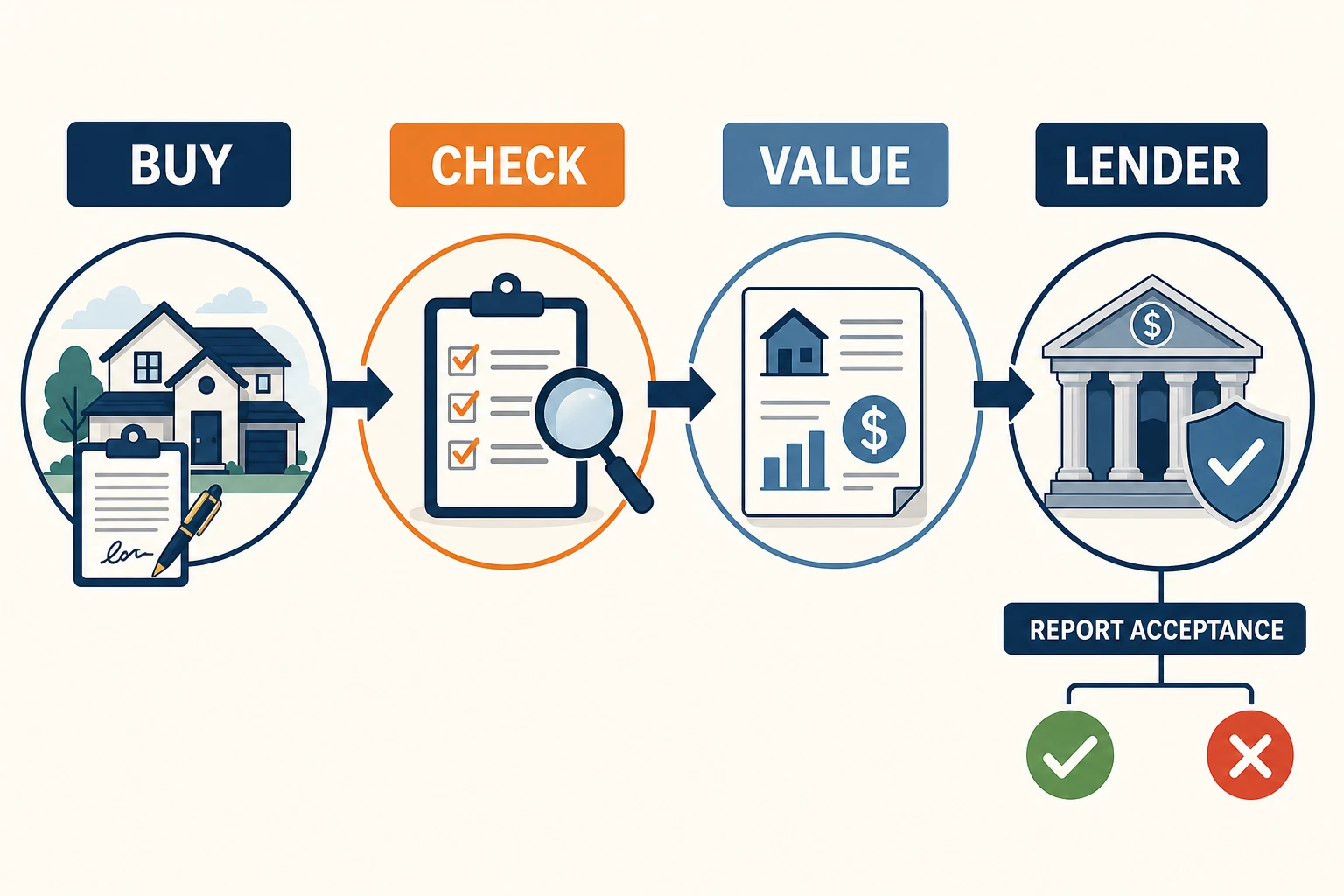
The option has consequences for evidence, timing and acceptance. The visual below shows the buyer’s sequence from purchase decision to lender acceptance.
Before you book an inspection, ask the lender which valuation report the lender accepts fits your application.
Physical valuation
A valuer visits the home, inspects it for the assignment and prepares a reasoned report. This option can be required when the loan or property conditions call for on-site evidence. It also gives the valuer a chance to notice features that are absent from a database.
When you compare proposals, ask each provider to break down property valuation quotes into scope, timing and total cost.
Hybrid valuation
A hybrid valuation combines model and property information with a remote review by a valuer. NHG describes approved uses and conditions. Its current information says a hybrid valuation can be limited to no more than 90% of the market value determined by that valuation. The lender’s rules still decide whether it works for your purchase.
Model-based valuation
A model-based result is generated from property and market information. It can support a process that explicitly accepts it. It has less scope for checking condition, unusual alterations, missing documents or a building feature that the input data does not capture.
The buyer’s valuation process in six steps
1. Ask for the requirement
Get the accepted report format and date rule from the lender or adviser. Do not rely on an estate agent’s assumption about what every bank accepts.
2. Tell the valuer the purpose
State that you are buying the property and need the result for a mortgage. Mention the lender, if known, and ask whether validation is included.
3. Share property facts
Send the address, purchase details, floor plans, leasehold information, renovation plans, permits and any documents already supplied.
4. Compare complete quotes
Ask whether the price includes the inspection, report, validation, travel, urgency and any extra research. Compare delivery dates against the mortgage deadline.
5. Check the draft or final report
Check the address, legal details, floor area, purpose, valuation date, assumptions and value. Ask for correction of factual errors before the lender receives the document.
6. Keep a record of acceptance
Save the lender’s confirmation, provider quote and final report together. This makes it easier to answer questions if the application changes.
Three purchase situations
A standard existing home
Ask whether the lender accepts a physical report from an independent registered valuer and whether validation is required. Give the valuer the same purchase and financing facts that the lender has.
A home needing renovation
Explain whether the mortgage includes works and whether the lender needs a value after improvement.
Supply plans and a cost estimate where available.
An apartment or unusual property
Tell the valuer about the VvE, leasehold, shared ownership, split title, rental status or unusual rights.
Mistakes that can delay financing
- Ordering a free estimate and assuming it will satisfy the lender.
- Choosing a provider because a seller or estate agent prefers it without checking acceptance.
- Leaving out renovation, leasehold or apartment information.
- Waiting until the mortgage deadline to ask about validation.
- Failing to check the report for address, floor-area or ownership errors.
- Treating an approved hybrid option as interchangeable with a physical option.
If the lender rejects a report, ask for the exact reason. A new report may not solve a missing document, wrong valuation date or format problem unless that cause is addressed.
Check the report before completion
Read the report when it arrives, even if the lender receives it directly. Confirm that the purpose, address and valuation date are correct. Compare the visible property facts with the home you agreed to buy. Report factual errors quickly because a correction can take time.
Do not treat the report’s market value as a guarantee of a future sale price. The valuation answers its defined assignment on its valuation date. Interest rates, buyer demand and property condition can change later.
Frequently asked questions
Do I need a valuation before making an offer?
Not always. A lender may ask for it after an offer is accepted or as part of the mortgage application. Ask the lender when it needs the report and how recent it must be.
Can I use a free online estimate for a mortgage?
Usually not as a replacement for the report format the lender requires. It can help you plan, while the lender decides which evidence it will use.
Can a hybrid valuation finance the full purchase price?
Do not assume so. NHG’s current information sets conditions for hybrid use and refers to a limit of no more than 90% of the determined market value. Your lender may apply its own policy.
Who pays for the valuation?
The buyer usually arranges and pays for the valuation in a purchase process, though the exact arrangement can differ. Ask the lender and request an itemised quote.
Is a valuation report a building survey?
No. A valuation is prepared for a value assignment. A building survey focuses on technical condition and likely repair costs. Arrange the second inspection if you need that evidence.
Buyer checklist
Before booking, make sure you can answer:
- What decision will the report support?
- Who will receive it?
- What format and validation are accepted?
- What valuation date and delivery date apply?
- Which documents and property features must be disclosed?
- Which costs are included in the quote?
Beste Taxateur helps you organise the questions and evidence around property valuation before buying a home, so you can compare providers and prepare the next step. The relevant lender, adviser, municipality or other party decides which report or evidence it accepts.
Ask a question about property valuation before buying a home