Property Valuation for Bridging Finance in the Netherlands
Understand how a property valuation supports bridging finance, which figures to prepare and why expected sale proceeds are not the same as guaranteed borrowing capacity.

TL;DR: calculate the gap, then confirm the lender’s rules
Bridging finance covers a temporary gap between buying a new home and receiving the proceeds from selling another one. A lender may ask for a valuation of the home being sold, but the valuation is only one input. The lender also assesses income, existing debt, the expected sale, costs, term and the risk that the sale takes longer or achieves a lower price.
If you are arranging bridging finance, keep local context such as property valuation in Beste Taxateur Voor Beleggingspanden in, Amsterdam separate from the lender’s assessment of proceeds, income and debt.
If you are refinancing, match property valuation for refinancing to the lender’s current requirements and valuation date.
The AFM mortgage guidance distinguishes the general loan-to-value framework from specific situations such as bridging credit. The lender’s current criteria decide the amount and accepted evidence. Ask for those criteria before you commission a report or sign a purchase contract.
Plan the bridge in this order:
- Establish the existing mortgage balance and the realistic net sale proceeds.
- List selling, buying, financing and temporary double-housing costs.
- Ask the lender which valuation report, date and assumptions it accepts.
- Test a lower sale price and a longer sale period, not only the optimistic case.
- Keep the bridge amount and exit plan subject to lender approval.
Does this situation match your question?
If you are a homeowner who has bought, or plans to buy, a new home before the current home has been sold. It is also useful when an adviser asks for a valuation to estimate the equity that may become available after the sale.
If the home has been renovated, record property valuation after renovation with the completed work, plans and supporting documents.
It does not calculate a personal borrowing limit. A mortgage adviser or lender must assess income, debts, affordability, product rules and the complete application. A valuer can report an opinion of value for a defined assignment; that opinion is not a sale promise.
Before you book an inspection, ask the lender which valuation report the lender accepts fits your application.
Context: why bridging finance is a timing problem
With an ordinary sale, the existing mortgage can often be repaid from the completion proceeds. With a bridge, the homeowner may temporarily carry the old mortgage, the new mortgage and the bridging loan. The amount that can eventually be repaid depends on the actual sale outcome, not only on the number in a valuation report.
If you are buying a home, match property valuation before buying to the mortgage question, valuation date and lender requirements.
The AFM sector letter on acceptance policy warns against treating the full expected value of an unsold home as immediately available without a margin for a price decline or a longer selling period. That is a risk principle, not a lender quotation for every application. It explains why a defensible plan includes buffers and sensitivity checks.
The body visual shows two homes connected by a temporary bridge, with valuation and cash-flow evidence between them. It does not indicate that a lender will approve the amount shown in any individual case.
If you are refinancing, match property valuation for refinancing to the lender’s current requirements and valuation date.
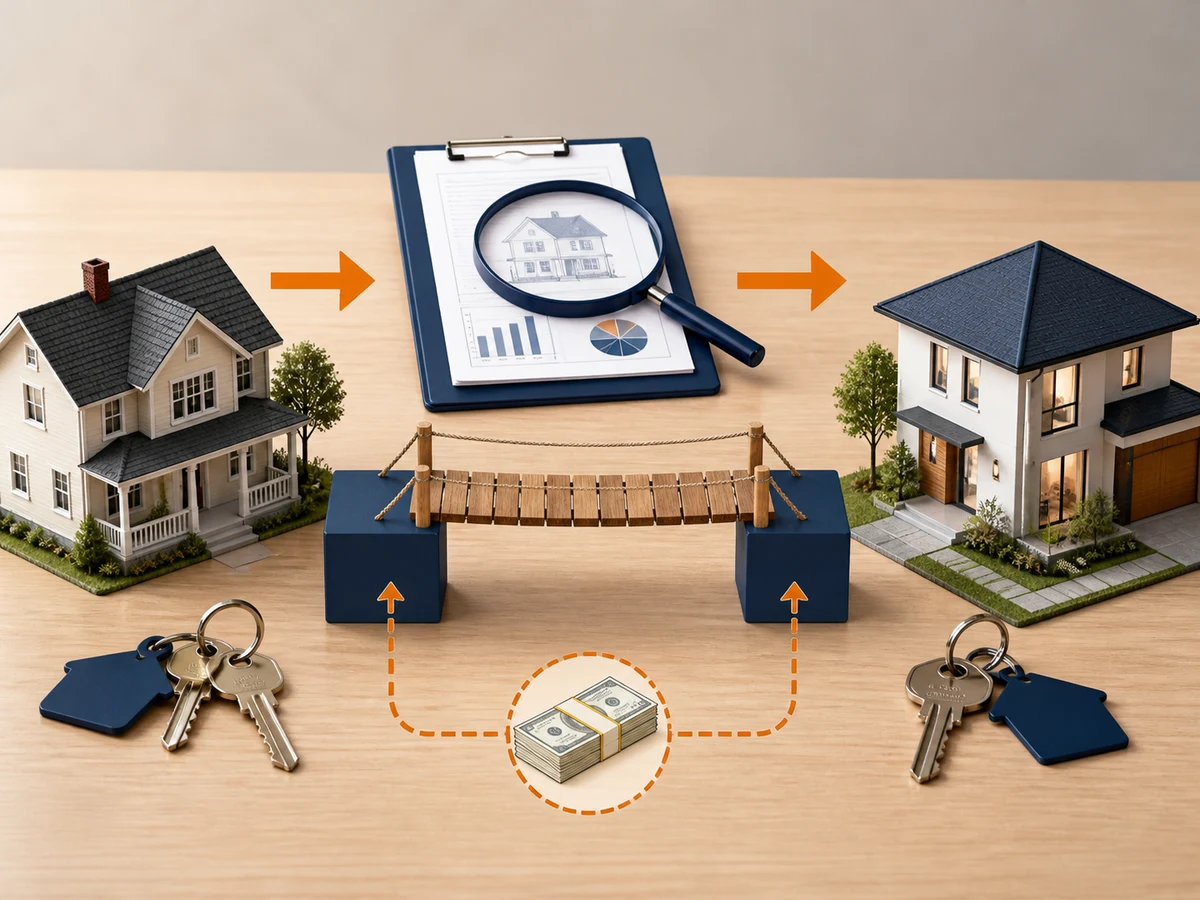
What you need before asking for a bridge
- Current home
- Prepare the address, ownership, mortgage balance, existing valuation, condition, improvements and any leasehold or legal restrictions.
- Expected sale
- Record how the expected sale value was formed, the asking-price strategy, comparable evidence and the costs needed to complete the sale.
- New home
- Collect the purchase price, completion date, deposit, required works and the lender's financing structure for the new property.
- Income and debt
- Give the adviser current income, other commitments, existing loans and evidence of affordability for the temporary period.
- Valuation request
- Confirm the purpose, report recipient, valuation date, accepted format and whether the lender wants a full report or another evidence route.
Constraints that can reduce the available bridge
Net proceeds are lower than gross value
Start with a realistic sale value, then subtract the existing mortgage, selling costs, possible redemption charges, agent fees, repairs, taxes where applicable and a contingency. The residual is a planning estimate of equity, not an amount that automatically becomes a bridge.
When you compare proposals, include property valuation costs in the total so extra work does not come as a surprise.
Timing creates a second risk
Interest, insurance, utilities and maintenance can continue while the old home is marketed. A slow sale can make the temporary period more expensive. Ask how long the lender permits the bridge and what happens if completion is delayed.
The report has a defined purpose
The receiving lender may require a recent report, a specific format or a valuation with particular assumptions.
A valuation is not a sale price
Market value, asking price and achieved sale price answer different questions. Do not use a valuation as evidence that a buyer will pay the same amount by a particular date.
The bridging-finance valuation process in six steps
1. Map both transactions
Write down the old-home mortgage, new-home price, completion dates and every point where money moves. Include the possibility that the two completions do not occur together.
2. Build a net-equity estimate
Use evidence for the current home’s value and subtract debt and transaction costs. Mark each figure as confirmed, estimated or dependent on another party.
3. Ask the lender for the evidence rule
Confirm whether the lender accepts a full valuation, a previous report, a WOZ value or another product. Ask about report age, format, validation and who must receive it.
4. Stress-test the plan
Run a lower sale value, a longer marketing period and higher temporary costs. The plan is more useful when it still shows what decision is required if the optimistic case fails.
5. Commission the right assignment
Give the valuer the purpose, date, recipient, property changes and relevant documents. Do not ask for a value that depends on an undisclosed sale assumption.
6. Review exit conditions
Before accepting the bridge, record how it is repaid, what happens after a delayed sale and which costs continue. Keep the adviser and lender’s written assumptions with the report.
Four situations that change the calculation
Current home already listed
A listing can provide market context, but it does not prove the achieved sale price. The lender may still apply its own margin and criteria.
Current home is not yet listed
The uncertainty is higher because the asking price, demand and marketing period are untested. Prepare comparable evidence and a conservative exit plan.
Renovation is expected before sale
Separate completed work from proposed work.
A construction budget does not automatically add the same amount to market value.
The move also changes the mortgage
A lender may assess refinancing, affordability and bridging together.
An illustrative calculation, not a borrowing promise
Suppose a homeowner plans around an expected sale value of €450,000. The existing mortgage is €260,000, estimated selling costs are €10,000 and a planning buffer is €30,000. The arithmetic is:
€450,000 - €260,000 - €10,000 - €30,000 = €150,000
The €150,000 is an illustrative residual planning figure. It is not a valuation, a lender limit or a guaranteed bridge. If the sale value falls, costs rise or the sale takes longer, the available amount changes. The lender may apply a different margin or reject the assumption altogether.
Mistakes that make bridge planning fragile
Treating the valuation as a guaranteed sale price
Why it happens: one precise number feels more certain than a range. Fix: separate market value, asking price, achieved price and lender haircut.
Forgetting the old mortgage interest
Why it happens: the new monthly payment gets most of the attention. Fix: budget both loans, the bridge, insurance and housing costs for a delayed sale.
Ordering the wrong report
Why it happens: the homeowner starts with the valuer rather than the recipient. Fix: confirm the lender’s format, date and acceptance first.
Using only the optimistic case
Why it happens: the best outcome makes the purchase appear affordable. Fix: model a lower price and longer sale period before committing.
Aftercare: keep the temporary plan under control
Review the bridge when the home is listed, when an offer arrives, when completion dates change and when the lender requests new evidence. Record the latest asking price, offers, costs and expected repayment amount.
If the report contains assumptions about condition, possession, planning or timing, make sure the adviser knows which assumptions still hold. If a material fact changes, ask whether the lender needs an updated valuation or a revised affordability assessment.
Frequently asked questions
Do I always need a property valuation for bridging finance?
No. The lender decides which evidence it accepts. A full report may be required, while another application may allow a different route. Ask the lender before commissioning anything.
Does a higher valuation mean I can borrow more?
Not automatically. Income, existing debt, lender policy, loan-to-value limits, sale costs and the risk margin still apply. The value is one input in a larger assessment.
Can I use the asking price as the value of my home?
An asking price is a marketing decision, not an independent opinion of market value. A lender may consider it as context, but it may require separate evidence.
What if my home does not sell before the bridge ends?
Ask the lender and adviser about the extension criteria, additional interest, repayment alternatives and the point at which the plan must change. Do not wait until the deadline to raise the issue.
Can renovation increase the bridge amount?
It can affect value, but the effect depends on the work, evidence, quality, legal status and market. A budget alone does not determine value.
Bridging-finance preparation checklist
- Old-home mortgage balance and redemption costs are confirmed.
- Expected sale value is separated from asking price and marked as an estimate.
- Selling, buying, financing and temporary double-housing costs are listed.
- A lower sale value and longer sale period have been modelled.
- The lender’s accepted valuation format, date and recipient are confirmed.
- The report purpose and property changes are disclosed to the valuer.
- The repayment plan and delay scenario are written down.
Beste Taxateur helps you organise the questions and evidence around property valuation for bridging finance, so you can compare providers and prepare the next step. The relevant lender, adviser, municipality or other party decides which report or evidence it accepts.
Ask a question about property valuation for bridging finance