Property Valuation for Insurance: Which Value Do You Need?
Understand when insurance needs rebuild cost, market value or another valuation, which documents matter and how to prepare a defensible request.

TL;DR: which property value does insurance need?
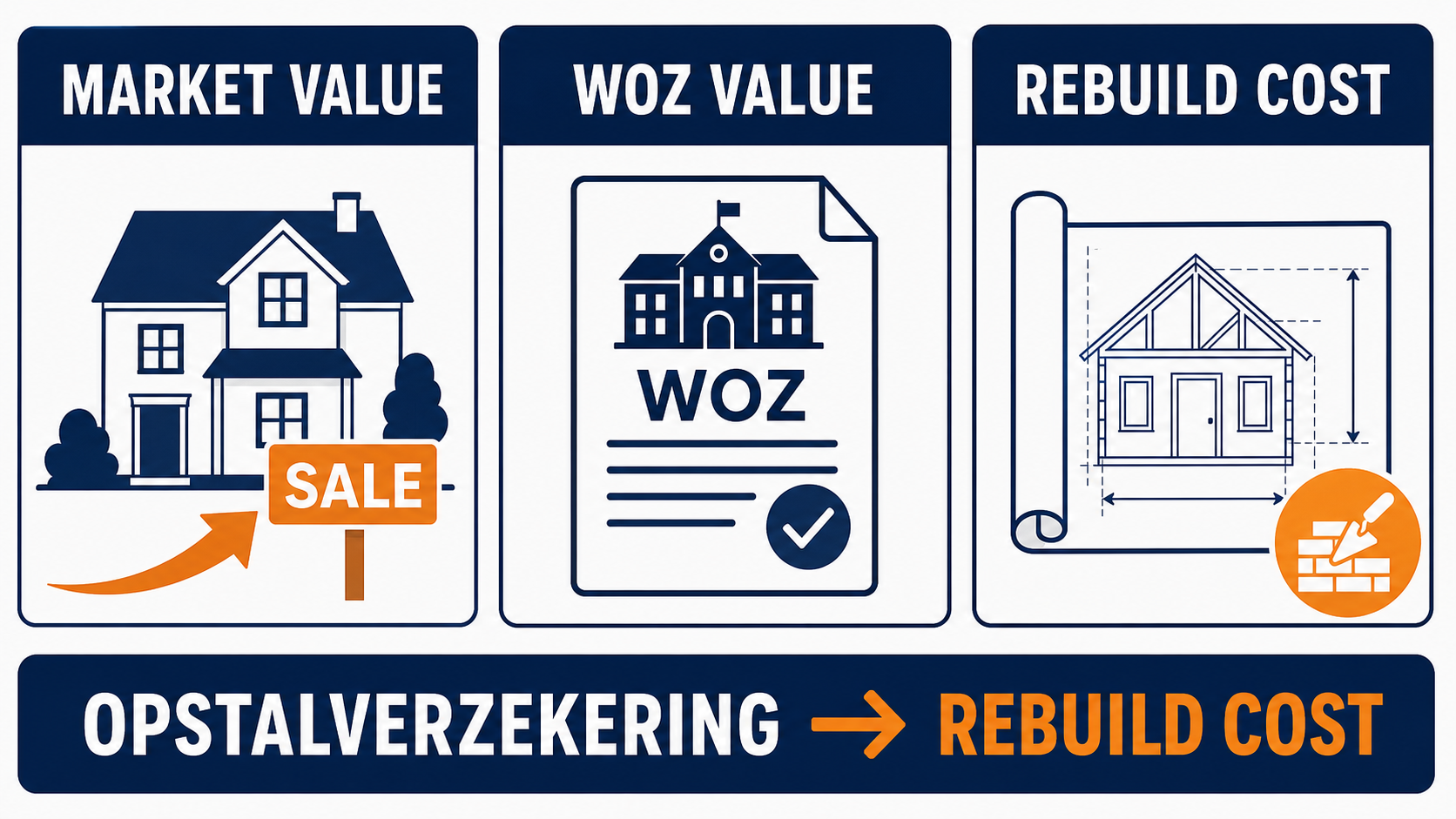
For a Dutch building insurance question, the relevant figure is often the cost of rebuilding the home, not its sale price and not its WOZ value. Rebuild cost asks what it would cost to reconstruct the insured building with comparable materials and standards after serious damage. Market value answers what the property could sell for. WOZ value is a municipal tax value with its own reference date.
If you are checking an insurance value, keep local market context such as property valuation in Desktop en Hybride Taxatie, Amsterdam separate from rebuild cost and the insurer’s own basis.
When you compare proposals, include property valuation costs in the total so extra work does not come as a surprise.
Start by asking the insurer which decision the figure supports: setting the sum insured, checking underinsurance, assessing a claim or resolving a dispute. Then ask which calculation method and documents it accepts. A private valuation can clarify a complex property, yet it does not automatically change the policy terms. Before you request a report, define valuation purposes by the decision the report must support.
The distinction matters because land value, location and buyer demand can raise a home’s market value without raising the cost of rebuilding the structure by the same amount. The reverse can also happen when specialist materials, access constraints or demolition requirements make rebuilding expensive.
Before you rely on the result, compare the valuation report contents with the question the assignment had to answer.
Does this situation match your question?
These checks help if you:
- homeowners checking whether the insured amount reflects a non-standard home;
- buyers who want to understand an insurer’s valuation question before completion;
- owners dealing with major damage, rebuilding or a coverage discussion;
- people comparing a rebuild-cost estimate with a WOZ or market valuation.
It is not a substitute for reading the policy wording. The insurer’s definition of the insured amount, guarantee against underinsurance and claims process controls the outcome.
Before you compare fees, ask each provider about property valuer selection criteria for your property and report recipient.
What you will need before you start
Collect the policy schedule, the insurer’s question, the property address, floor area and construction year. Add information about extensions, outbuildings, solar panels, unusual finishes, foundation type and recent structural work. Keep permits, drawings, invoices and photographs available when they explain the building better than a short description.
When the report arrives, compare its purpose, date and evidence with reading a valuation report.
If the insurer has supplied a form, ask which fields are essential and whether a professional report is required. This prevents paying for a market valuation when the policy actually needs a rebuild-cost estimate.
If you need a mortgage report, match mortgage valuation to the lender’s requirements before you book an inspection.
Context: why the value basis changes the answer
An insurer, lender and buyer can ask about the same house for different reasons. A mortgage lender normally focuses on market value and report acceptance. A building insurer focuses on the cost of restoring or rebuilding the insured structure. A municipality uses the WOZ system for tax purposes. When you compare the two figures, keep WOZ value and market value tied to its own purpose and reference date.
The public Dutch Herbouwwaardemeter was last published for 2025, according to the the insurer association’s rebuilding-cost figures. That does not mean older figures are useless as background. It means you should ask your insurer which current model, index or inspection method applies in 2026.
Detailed prerequisites and constraints
Confirm the question in writing
Ask whether the insurer needs a sum-insured estimate, a rebuild-cost calculation, a market valuation or evidence for a claim. Use the exact wording in the policy or claim correspondence. If the request is unclear, ask the claims handler what the report will be used to decide.
If leasehold affects your property, include leasehold property valuation in the brief before the valuation starts.
Describe the property beyond its postcode
Record gross and usable floor area, number of floors, roof form, construction, finish level and attached or detached structures. A house with a standard layout may fit an insurer’s model more easily than a listed, architect-designed or partly commercial property. That difference is a reason to disclose facts, not a reason to guess a higher figure.
If your question concerns tax or WOZ, keep the tax rule and WOZ and market value explanation as separate parts of the assessment.
Check the policy limits
Look for a guarantee against underinsurance, indexation, maximum amounts and exclusions. A guarantee may depend on accurate information or use of the insurer’s own method. A report prepared for another purpose may be informative while still failing the policy’s formal requirement.
Step-by-step: prepare the insurance valuation request
- Name the insurance decision. Write one sentence stating whether you are setting cover, reviewing a sum insured or supporting a claim.
- Ask for the value basis. Confirm whether the insurer wants rebuild cost, market value or another measure.
- Request the accepted method. Ask whether the insurer uses a questionnaire, model, index, inspection or approved professional report.
- Prepare property evidence. Gather plans, permits, measurements, construction details, photos and invoices that affect rebuilding.
- Compare the proposal with the policy. Check the assumptions, exclusions, date and treatment of extensions or special features.
- Save the evidence trail. Keep the request, answers, calculations and final report with the policy documents so a future claim can be understood.
Examples, scenarios and variations
A standard owner-occupied house
The insurer may be able to estimate rebuild cost from dimensions, construction year and property features. Your main task is to disclose extensions, solar panels, outbuildings and unusual finishes. A market valuation may still be useful for a mortgage, yet it answers a different question.
A listed or heavily renovated property
Specialist materials, heritage requirements, restricted access and architect oversight can change rebuilding work. Ask whether the insurer wants a professional inspection and whether the policy covers the additional cost. Do not assume that a recent purchase price captures those construction requirements.
Troubleshooting and common mistakes
Mistake: sending only the WOZ notice
The WOZ value is designed for municipal taxation and has its own reference date. Send it only when the insurer asks for it or as context alongside the requested evidence.
Mistake: treating market value as the rebuilding budget
Sale value includes land, location and demand. Rebuild cost focuses on the structure and the work needed to restore it. Ask the insurer to confirm the value basis before commissioning a report.
Mistake: overlooking later improvements
An extension or converted attic can change the insured building even when the original policy remains unchanged. Tell the insurer what changed and when.
Mistake: assuming a calculator guarantees cover
A calculator produces an estimate under its inputs. Policy wording, guarantees and exclusions still decide how a claim is assessed. Request written confirmation when the consequence is material.
Aftercare: review, update and repeat
Review the property information after a structural renovation, extension, change of use or major change in finish. Keep the date of the estimate visible. Do not replace the original date merely because you rebuilt the website or opened the file again.
After a serious claim, compare the report with the visible damage, repair scope and policy definition. If the evidence conflicts, ask the insurer which fact needs clarification before ordering another valuation.
FAQ about property valuation for insurance
Is a WOZ value suitable for building insurance?
Usually it is not the same measure as rebuild cost. A WOZ notice can provide background, but the insurer’s requested method should control the calculation.
Do I need a property valuer for a home insurance policy?
Not always. Some insurers calculate the sum insured from a questionnaire or their own model. A professional inspection can be useful for unusual, high-value or difficult-to-describe buildings, subject to the insurer’s acceptance.
Does a market valuation prove that I am insured correctly?
No. Market value and rebuild cost answer different questions. A market valuation may help with a sale or mortgage while the building policy uses another basis.
How often should I review the insured value?
Review it after material building changes and when the insurer requests updated information. Also check the policy’s indexation or review provisions instead of applying a generic annual rule.
What should I ask a valuer to include?
State the insurance purpose, requested value basis, valuation date, property features and any special assumptions. Ask who will use the report and whether the insurer has confirmed acceptance.
What can you check before you act?
What should you review before relying on the result?
Before relying on an insurance valuation, check that the purpose, value basis and date are explicit. Confirm that extensions and special features are recorded, the policy’s guarantees and exclusions were reviewed, and the insurer has accepted the proposed method. Review the advice when Dutch insurance guidance or the insurer’s calculation method changes.
Beste Taxateur helps you organise the questions and evidence around property valuation for insurance, so you can compare providers and prepare the next step. The relevant lender, adviser, municipality or other party decides which report or evidence it accepts.
Ask a question about property valuation for insurance