Property Valuation During Divorce in the Netherlands
How to arrange a property valuation during divorce, compare selling with a buyout and prepare a fair evidence file for both parties.

TL;DR: value the home before dividing it
When a couple separates, decide first whether the home will be sold or one partner will buy out the other. In both cases, write down the valuation date, the ownership shares, the mortgage balance and the report recipient. Ask for a market valuation that matches that decision; do not treat the WOZ value, an estate-agent estimate and a formal report as interchangeable.
If you are dividing a home, keep local context such as property valuation in Aankoop Taxatie Starters, Amsterdam separate from ownership shares, the mortgage and the agreed valuation date.
When the report arrives, compare its purpose, date and evidence with reading a valuation report.
The Belastingdienst explains the buyout calculation with a home valued at €500,000 and a mortgage of €300,000. The equity is €200,000, so an equal half would be €100,000 before other agreements and costs. If the parties agree on €70,000 instead, the difference may have tax consequences. The example shows why the arithmetic and the legal agreement must be kept visible.
Use this sequence:
- Confirm the sale or buyout route.
- Confirm ownership shares and the relevant date.
- Gather mortgage, property and agreement documents.
- Commission an independent report with a clear scope.
- Check the report before using it in the settlement or mortgage process.
Does this situation match your question?
If you are a homeowner who is separating or divorcing and need a defensible value for a sale, buyout, refinancing or division of assets. It is also useful for a mediator or adviser who wants both parties to work from the same property evidence.
The Belastingdienst sale guidance explains the difference.
The aim is to separate three questions: what the home is worth, how much debt remains and who is entitled to what share. Keeping them separate prevents one unexamined number from carrying all three decisions.
If you and the other owner question the result, request a second-opinion property valuation that uses the same valuation date and tests the supporting evidence.
Why the valuation matters in a separation
The home may be the largest shared asset. A difference in value changes the equity calculation, the amount needed for a buyout and the borrowing capacity of the partner who stays. A difference in the valuation date can also matter when the market or the property changes.
If you are selling, match property valuation before selling to the sale decision, valuation date and negotiation.
The Belastingdienst distinguishes selling from one partner remaining and buying out the other. It also explains that a sale can leave overvalue or residual debt, which is then divided according to the relevant ownership position.
The body visual shows the logic: shared property evidence feeds a valuation and debt calculation, then the result supports either a sale decision or a buyout decision. It is a decision map, not a settlement calculator.
When the report arrives, compare its purpose, date and evidence with reading a valuation report.
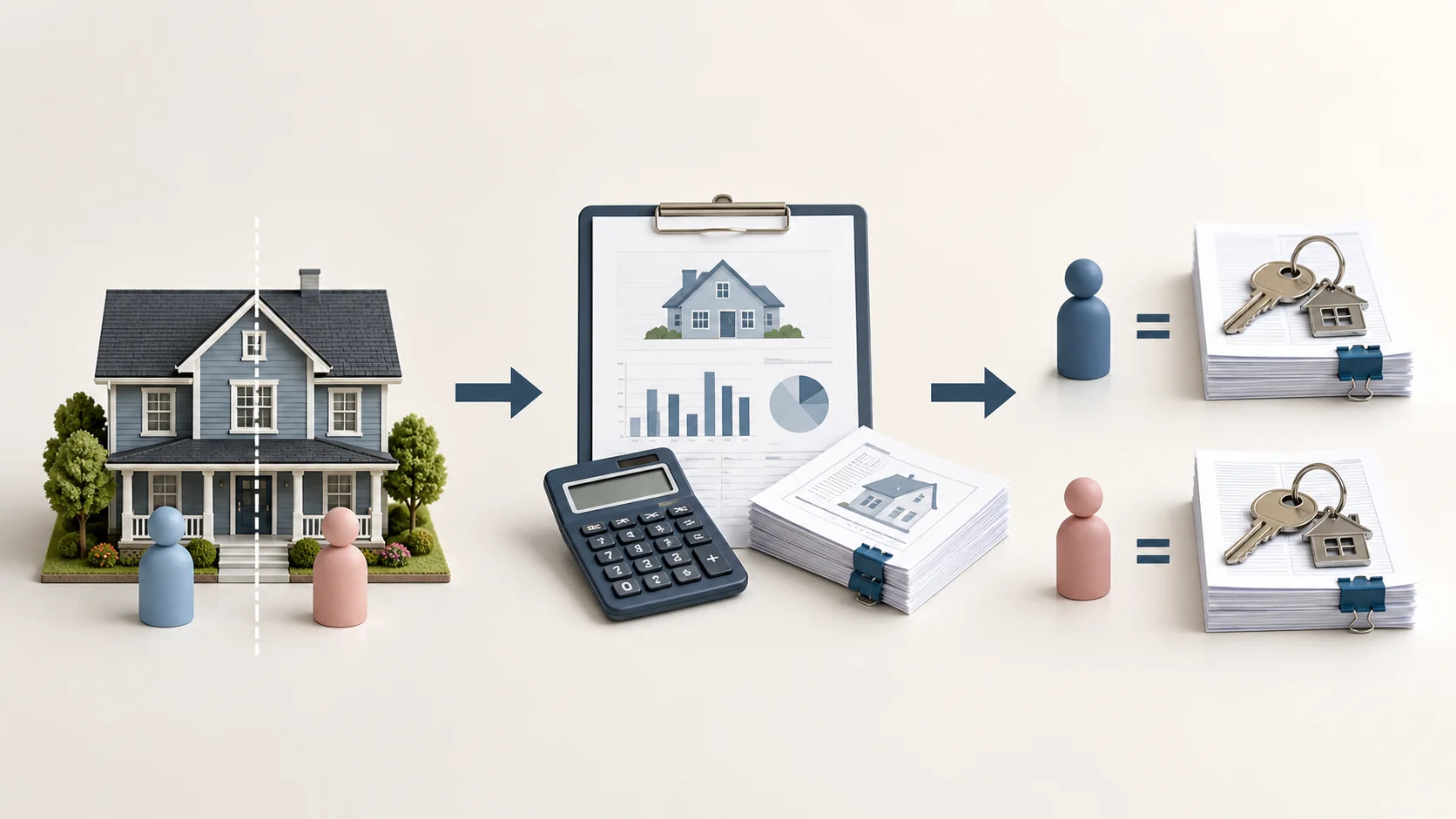
Documents and decisions to assemble
Make a shared document list. If one person has a document and the other does not, record the gap instead of treating it as irrelevant.
Before you book an inspection, ask the lender which valuation report the lender accepts fits your application.
- Decision and date
- Record whether the home will be sold, transferred or refinanced, and which valuation date the agreement or lender requires.
- Ownership position
- Collect the deed, marital or partnership agreement, divorce agreement drafts and any arrangement that changes the shares.
- Mortgage and insurance
- Request the current mortgage balance, repayment details, fixed-rate information and any linked insurance that affects the financing plan.
- Property evidence
- Provide floor area, plans, permits, renovation records, leasehold, VvE information, energy improvements and known defects.
- Report recipient
- Ask the lender, mediator, notary or tax adviser what report format, date and evidence it will accept.
- Cost assumptions
- List selling costs, repayment costs, transfer costs and any agreed adjustment separately from the property value.
Value, equity and transfer price are different numbers
Market value
A valuation report can give a reasoned market value on a stated date. It considers the property, the market, comparable evidence, condition, legal position and assumptions within the assignment.
If the value will be used in a dispute, match property valuation for legal proceedings to the legal question and evidence required.
Equity
Equity is the value of the home minus the debt that must be considered. In the Belastingdienst example, €500,000 minus €300,000 leaves €200,000. The next question is how that equity is allocated; equal shares are not a safe assumption in every ownership or agreement.
If you are dealing with an inherited home, match property valuation for inheritance to the tax, sale or division decision.
Transfer price
The amount one partner pays the other can differ from a simple half of the equity. It may include other assets, costs, maintenance, tax arrangements or a deliberate gift. That difference needs advice; it should not be hidden by changing the reported property value.
Lender value
If the partner who stays needs new or increased borrowing, the lender may require its own current report.
A report used in a family agreement may not satisfy the lender.
The divorce valuation process in six steps
1. Choose the route
Discuss whether the home is to be sold, transferred or kept by one partner. If the decision depends on financing, ask the lender before agreeing the timetable.
2. Confirm shares and date
Ask the notary or mediator to confirm the ownership position. Put the valuation date in the written instruction and explain why it matters.
3. Prepare one factual brief
Send property, mortgage, renovation and legal information to the valuer. Include the questions that both parties want answered, but do not ask the valuer to interpret the divorce agreement.
4. Compare complete proposals
Compare the inspection, report scope, valuation date, turnaround, validation and included work. A low fee can conceal a report that cannot be used by the intended recipient.
5. Review the report together where possible
Check the address, ownership description, floor area, condition, comparable sales, assumptions, restrictions and conclusion.
6. Apply the numbers with the right advisers
Use the report as property evidence. Have the notary, mediator, tax adviser and lender address the agreement, tax treatment and financing consequences that sit around it.
Four separation situations
One partner buys out the other
The staying partner needs a value, a mortgage calculation and a clear ownership transfer. Check whether the lender accepts the report and whether the transfer amount differs from the share of equity.
The home is sold
Sale proceeds can produce overvalue or residual debt.
Record selling costs and debt repayment separately.
The home has major renovations
Provide permits, invoices, plans and the status of the work. A value “after completion” is not the same as the value on the separation date.
One partner has moved out
Occupation, payments and maintenance may form part of the agreement, but they do not automatically change the property’s market value. Keep the occupancy history in the brief and ask the adviser how it affects the settlement.
Mistakes that make a settlement harder
- Using a WOZ notice as the agreed market value without checking the purpose.
- Changing the valuation date because the report arrived later.
- Leaving out an informal renovation, leasehold term or structural issue.
- Treating the mortgage balance as the property value.
- Asking one party’s preferred provider to define the other party’s rights.
- Agreeing a buyout before checking lender acceptance and tax implications.
- Requesting a second report without stating what evidence or assumption is disputed.
An informed critic might say that the parties can agree any number and do not need a report. They may be able to agree, but the agreement can still affect tax, financing and the fairness of the division. The report is most useful when it makes the assumptions visible, not when it pretends to remove negotiation.
What to do after the report
Save the report, the supplied evidence and the final agreement together. Record any correction and keep the original version. If the transfer or sale is delayed and the market or home changes materially, ask whether a new valuation date or update is needed.
If the parties disagree, name the disputed item.
A factual error, a missing comparable, an ownership issue and a different opinion about market conditions need different next steps.
Frequently asked questions
Do we need a valuation if one partner stays in the home?
Often it is useful, especially when the staying partner must buy out the other or refinance. The lender, notary or agreement may define the required report and date.
Is the WOZ value enough for a buyout?
Not automatically. WOZ serves a municipal and tax framework. A buyout normally needs a value that reflects the agreed property decision and date. Ask the adviser what evidence is required.
What if the valuation is higher than the sale price?
That does not automatically prove the report is wrong. A later sale reflects its own date, negotiations, marketing and costs. Check whether the report and transaction answer the same question.
Can the valuation include the mortgage?
The report values the property. The mortgage is debt. Keep the two figures separate before calculating equity.
Can we request a second opinion?
Yes, if there is a defined concern and the new valuer can work independently. Preserve the first report and explain the question instead of asking for a preferred number.
Separation valuation checklist
Before booking, check:
- Sale, buyout or refinance route is identified.
- Ownership shares and the valuation date are confirmed.
- Mortgage balance and linked financing information are current.
- Renovation, leasehold, VvE and condition details are disclosed.
- The recipient’s report and validation requirements are written down.
- Value, debt, costs and transfer price are kept as separate calculations.
Beste Taxateur helps you organise the questions and evidence around property valuation during divorce Netherlands, so you can compare providers and prepare the next step. The relevant lender, adviser, municipality or other party decides which report or evidence it accepts.
Ask a question about property valuation during divorce Netherlands