Logistics Property Valuation in the Netherlands: What to Prepare
Learn how access, loading, clear height, yard space, floor strength, lease terms and market evidence shape a logistics property valuation.

TL;DR: value usable capacity
A logistics property valuation needs more than warehouse area and a transport label. Define the purpose, value basis, valuation date and recipient. Then assemble evidence about permitted use, access, loading, yard space, clear height, floor strength, power, layout, condition, lease and comparable logistics property. If this is your situation, use the steps below to decide which facts and questions matter for you.
If you are valuing business premises, keep local market evidence such as property valuation in Blixembosch West, Eindhoven separate from the building’s commercial use, lease and income.
If you are valuing an industrial building, define industrial property valuation around its use, condition and market evidence.
The NRVT’s commercial valuation standards connects assignment, data, methods, reporting and uncertainty. A report should show which evidence supports the conclusion and which assumptions still need checking.
The RVO utility-building guidance sets out utility-building functions, sale and lease moments and exceptions. Confirm the actual function before drawing a conclusion about an energy label. A label point does not describe loading capacity, rent or market value.
Prepare the file in this order:
- Define the decision, value basis, date and recipient.
- Check permitted use, access, loading rights and site movement.
- Record clear height, floor strength, power, layout, yards and condition.
- Assemble leases, income, energy information and market evidence.
- Review method, adjustments, assumptions and uncertainty against the brief.
Does this situation match your question?
If you are an owner, buyer, landlord, lender, investor or adviser dealing with a warehouse, distribution centre, fulfilment unit or logistics property in the Netherlands.
If you are valuing a commercial property, define commercial property valuation around its use, income and physical evidence.
It does not value a named building. Transport, planning, environmental, fire, energy and technical questions may need specialist work alongside a property valuation.
If you are valuing an industrial building, define industrial property valuation around its use, condition and market evidence.
Context: logistics value follows movement and capacity
A logistics building has value for a defined user when goods can reach it, move through it and leave it under workable legal and physical conditions. Access for trucks, turning space, loading bays, yard depth, clear height, floor strength, power, storage layout and operating hours can affect the users who can occupy it.
If you are valuing a commercial property, define commercial property valuation around its use, income and physical evidence.
The legal position can limit the market. A property described as logistics may have another permitted use, access restriction or environmental condition. Check planning information and rights before treating the current operation as transferable.
The body visual shows a warehouse plan, site movement, building specification and lease evidence. Its numbers are illustrative design elements, not measurements for a real property.
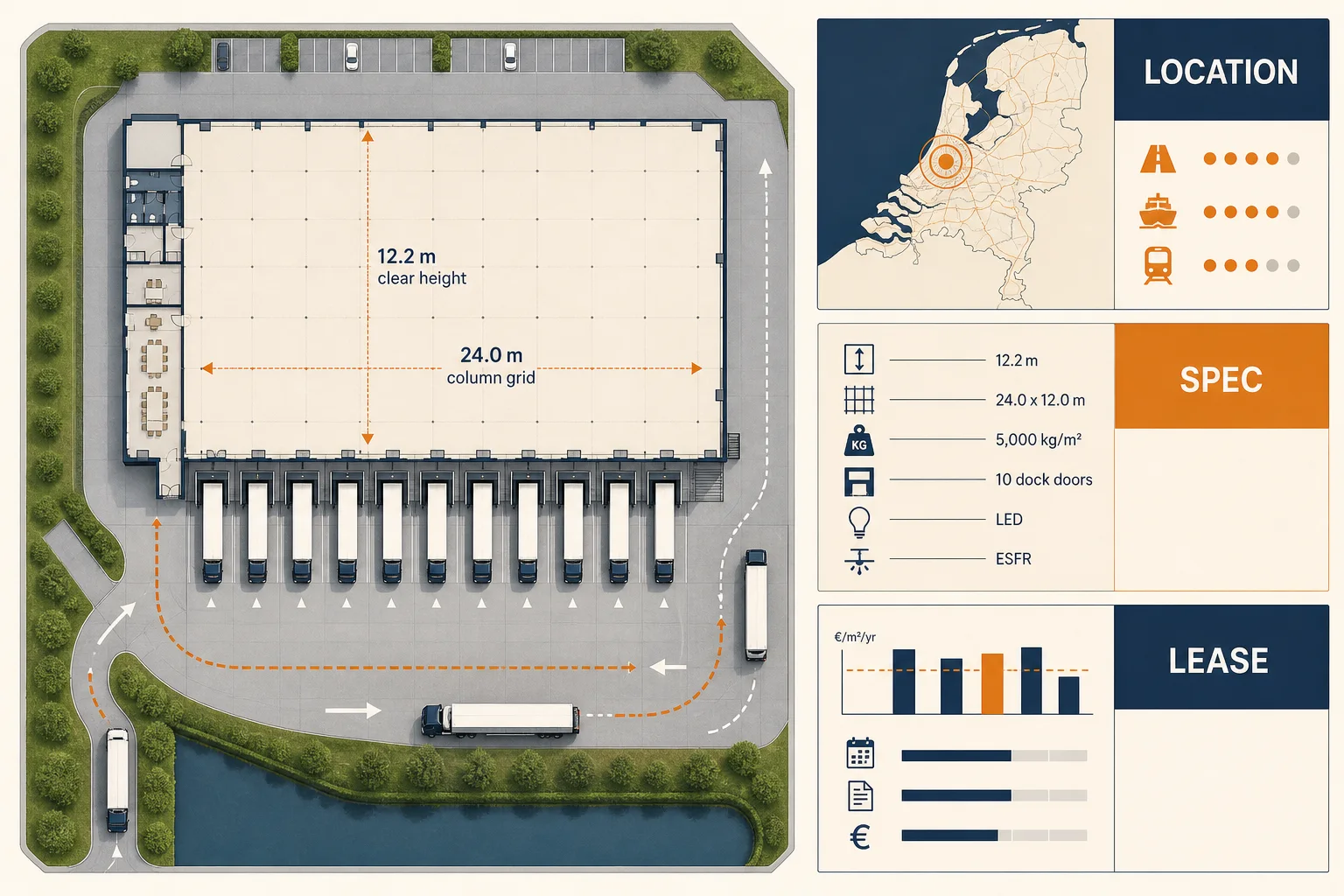
Logistics valuation evidence to assemble
- Assignment
- Record purpose, value basis, valuation date, recipient, format and assumptions.
- Use and rights
- Collect permitted use, environmental activity, permits, access rights, operating limits and proposed changes.
- Access and yard
- Describe roads, turning, loading bays, yard depth, delivery hours, parking, congestion and site circulation.
- Building capacity
- Provide clear height, floor strength, column grid, storage layout, power, installations, offices and fire measures.
- Lease and income
- Share rent, indexation, incentives, break rights, service charges, arrears, deposits and tenant duties.
- Market evidence
- Ask for dated sales, rents or income references with a comparable use, access, size, lease and condition.
Constraints that can change the result
Area does not equal usable capacity
Two warehouses with the same area can offer different storage or loading capacity. Clear height, columns, floor strength, sprinkler systems, yards and access may matter more to the target user.
Access is a property fact
A location beside a motorway does not prove that trucks can reach the loading bays at the required times. Check rights, road geometry, turning, restrictions and neighbour conditions.
Legal use can differ from marketing language
Confirm planning information, environmental permissions and operating limits. A current tenant’s activity is not automatic proof that the same activity transfers to a buyer or new tenant.
Lease and building fit interact
A long lease may support income evidence while the building becomes less suitable for a future user. Read rent, indexation, repairs, break rights and tenant duties with the physical inspection.
Energy information has a defined role
Confirm the function and current RVO rule. Keep label status, installation condition, improvement needs, running costs and demand as separate questions.
The logistics valuation process in six steps
1. Define the decision
State whether the report is for sale, purchase, finance, refinancing, lease, accounting or a dispute. Name the value basis, date and recipient.
2. Verify use and rights
Check ownership, permitted use, environmental conditions, access, easements, operating times, restrictions and proposed changes.
3. Describe movement and capacity
Record loading, yard, turning, clear height, floor strength, columns, power, storage, offices, fire systems and condition.
4. Build the income and cost file
Provide leases, rent roll, incentives, service charges, maintenance, capital plans, energy information and tenant obligations. Mark missing evidence.
5. Compare relevant evidence
Review date, access, use, size, capacity, lease, condition and income basis for each comparable. Ask why a sales, rent or income method fits the question.
6. Review the report against the brief
Check use, areas, capacity, rights, lease figures, assumptions, method, date, value basis and uncertainty.
Four logistics-property situations
Distribution warehouse
Loading, yard, clear height, storage layout, transport access and lease terms may shape the user pool. Compare with buildings that can support a similar movement pattern.
Fulfilment centre
Power, automation, staff movement, loading, fire systems, parking and operating hours can matter. Keep movable equipment and the building within a clear scope.
Last-mile unit
Access times, urban restrictions, smaller loading areas, parking and neighbour conditions may matter more than plot size. Use local evidence with a similar access pattern.
Vacant logistics building
There may be no current tenant evidence. Focus on permitted use, works, access, capacity, costs, timing, lease evidence and the market for a future user.
Mistakes that weaken a logistics valuation
Comparing only area and postcode
Why it happens: those fields are easy to search. Fix: add loading, yard, height, floor strength, access, use, lease and condition.
Calling every warehouse logistics property
Why it happens: marketing language is repeated. Fix: verify permitted use, access, environmental conditions and actual capacity.
Treating a motorway location as a rating
Why it happens: proximity sounds measurable. Fix: review the real road, turning, delivery, time and neighbour conditions.
Hiding equipment in the building total
Why it happens: automation and racking can be attached or expensive. Fix: list fixtures, movable equipment and the agreed asset scope.
Aftercare: keep the file current
Keep the report with leases, plans, access rights, permits, maintenance records, system information, energy evidence and market references. Revisit the file when a tenant changes, loading is altered, automation is added, access rules change or a major repair is completed.
If the next decision has another purpose or valuation date, ask whether a new assignment is needed. Logistics value can move when a lease, access condition or capacity feature changes even if the shell remains the same.
Frequently asked questions
Is logistics property valued per square metre?
Area can be one input, but usable capacity, access, loading, height, floor strength, use, lease, condition and market evidence also matter.
Does a good transport location guarantee a higher value?
No. The building must also support the required movement, loading, storage, legal use, lease and operating conditions.
Does a warehouse need an energy label?
The general utility-building rule has exceptions that depend on function and current guidance. Check the actual building and the current RVO information.
Can equipment be included?
Only when the assignment defines that scope and the evidence is available. Distinguish fixtures, movable equipment, racking and the building.
What should I send first?
Send the purpose, address, plans, permitted use, access information, lease, rent details, condition records and report requirements of the recipient.
Logistics valuation checklist
- Purpose, value basis, valuation date, recipient and asset scope are written down.
- Permitted use, environmental conditions, access rights and restrictions are checked.
- Loading, yard, turning, clear height, floor strength and operating hours are described.
- Layout, columns, power, installations, offices, fire measures and condition are documented.
- Lease, rent, indexation, incentives, service charges and tenant duties are provided.
- Equipment, automation, racking and fixtures are separated from the building scope.
- Comparable logistics evidence is dated and adjusted for access, capacity, lease and condition.
Beste Taxateur helps you organise the questions and evidence around logistics property valuation, so you can compare providers and prepare the next step. The relevant lender, adviser, municipality or other party decides which report or evidence it accepts.
Ask a question about logistics property valuation