Healthcare Property Valuation in the Netherlands: What to Prepare
Learn how use, access, layout, building condition, lease and care-specific evidence shape a healthcare property valuation.

TL;DR: value the building for its care use
A healthcare property valuation needs more than floor area and a building age. Define the purpose, value basis, valuation date and recipient. Then assemble evidence about permitted care use, access, circulation, rooms, installations, condition, lease, energy information and comparable healthcare property. If this is your situation, use the steps below to decide which facts and questions matter for you.
If you are valuing business premises, keep local market evidence such as property valuation in Elzent Noord, Eindhoven separate from the building’s commercial use, lease and income.
If you are valuing a commercial property, define commercial property valuation around its use, income and physical evidence.
The NRVT’s commercial valuation standards connects assignment, data, methods, reporting and uncertainty. A clear brief also states whether the scope includes fixtures, equipment, business activity or only the real estate.
The RVO utility-building guidance includes healthcare among the utility-building functions in its overview. Sale, lease and completion rules have exceptions that depend on the building. Label status does not show whether a care facility works for patients, staff or a new operator.
Prepare the file in this order:
- Define the decision, value basis, date and recipient.
- Check care use, access, permissions, layout and site movement.
- Record rooms, installations, condition, energy information and planned works.
- Separate property income from care services, equipment and goodwill.
- Review the method, assumptions and uncertainty against the brief.
Does this situation match your question?
If you are an owner, buyer, landlord, lender, investor or adviser dealing with a clinic, care home, day-care centre, medical office or other healthcare building in the Netherlands.
If you are valuing a commercial property, define commercial property valuation around its use, income and physical evidence.
It does not assess a named provider or patient service. Building, planning, fire, accessibility, health and lease questions may need specialist work alongside a valuation.
If you are valuing an office, define office property valuation around rent, use, vacancy and comparable properties.
Context: care fit is a property question and a service question
Care use can place demands on the building and site. Arrival, accessible parking, circulation, lifts, room sizes, privacy, sanitation, storage, treatment areas, staff areas, emergency access and installations can affect the group of users who can operate there.
If you are valuing a commercial property, define commercial property valuation around its use, income and physical evidence.
The service is a separate layer. Patient numbers, staff, contracts, care funding and operating performance describe a provider. They should not be folded into real-estate value without a defined assignment and reliable evidence.
The body visual links building, care use and lease evidence. It is a reading aid, not a compliance certificate or value model.
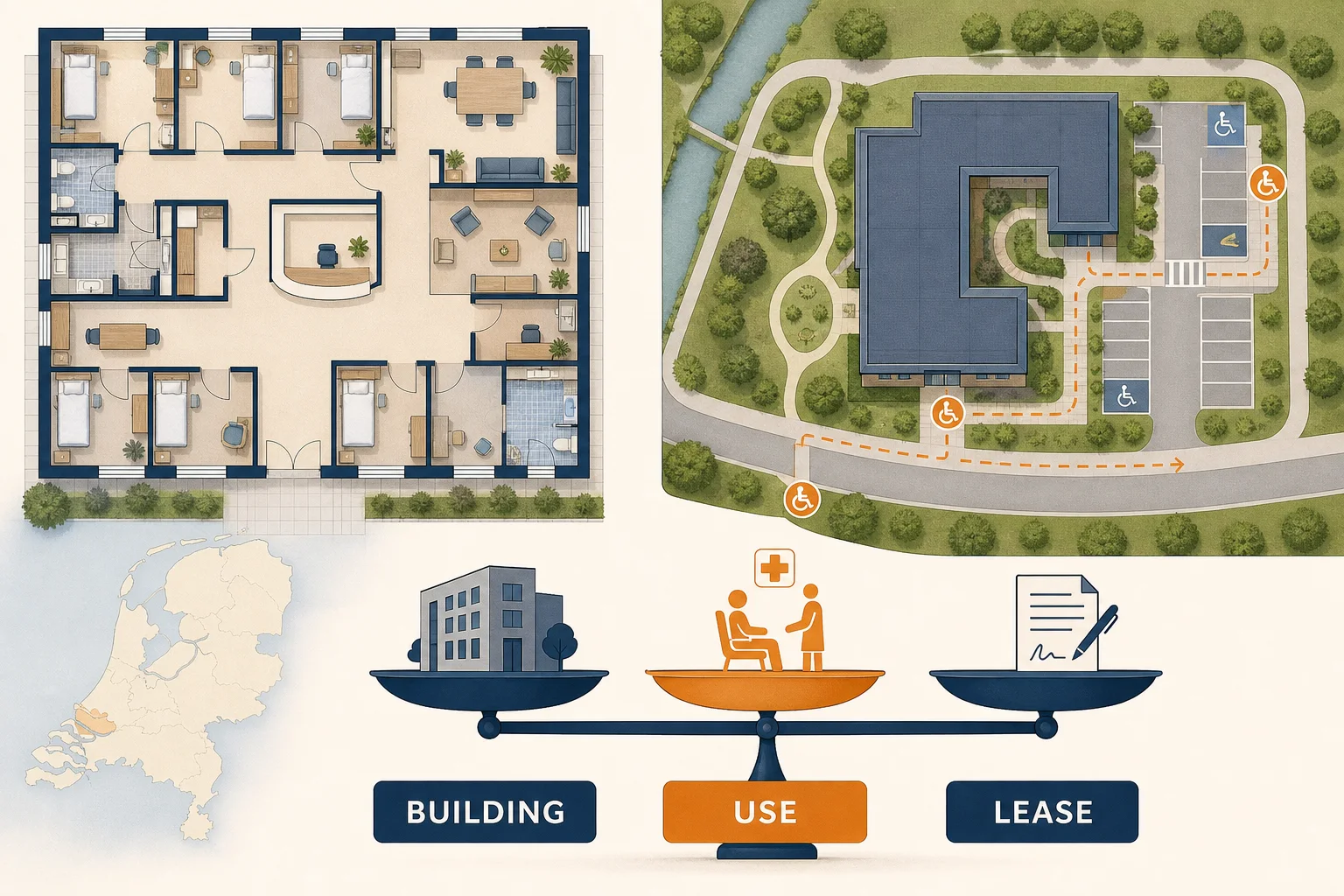
Healthcare valuation evidence to assemble
- Assignment
- Record purpose, value basis, valuation date, recipient, format, assumptions and the treatment of equipment or fixtures.
- Use and permissions
- Collect permitted use, current service, permits, operating conditions, restrictions and any proposed change.
- Access and site
- Describe arrival, parking, accessible movement, emergency access, deliveries, public transport and shared areas.
- Building and systems
- Provide room schedule, areas, lifts, sanitation, ventilation, power, fire systems, maintenance records and planned works.
- Lease and income
- Share rent, indexation, incentives, break rights, service charges, arrears, deposits and tenant duties.
- Market evidence
- Ask for dated sales, rents or income references with a similar care use, location, size, lease and condition.
Constraints that can change the result
A care label does not prove functional fit
The current use may depend on a layout, permission or installation that will not suit another operator. Check the actual rooms, movement, access and legal position.
Service income is not property income
Care revenue can depend on contracts, staffing, funding and provider skill. Keep it separate from rent and building evidence unless the assignment says otherwise.
Accessibility needs a physical review
A ramp, lift or marked parking space in a plan does not prove that movement works in daily use. Record the site and building evidence and state what still needs specialist review.
Systems can be use-specific
Ventilation, backup power, medical gases, fire measures, lifts and sanitation can affect cost and use. Do not infer condition from a recent fit-out alone.
Energy information has a defined role
Confirm the building function and current RVO rule. Keep label status, installation condition, improvement needs, running cost and user demand as separate questions.
The healthcare valuation process in six steps
1. Define the decision
State whether the report is for sale, purchase, finance, refinancing, lease, accounting or a dispute. Name the value basis, date and recipient.
2. Verify use and rights
Check ownership, permitted care use, permits, access, restrictions, shared areas and any proposed change.
3. Describe the building and site
Record areas, rooms, circulation, lifts, parking, sanitation, installations, fire measures and condition. State what equipment and fixtures belong to the scope.
4. Separate property and service evidence
Place rent, lease clauses and service charges with property information. Keep care contracts, staffing, patient numbers, equipment and goodwill in a separate block.
5. Compare relevant evidence
Review date, use, location, size, lease, condition and income basis for each comparable. Ask why a sales, rent or income method fits the question.
6. Review the report against the brief
Check use, areas, rights, lease figures, assumptions, method, date, value basis and uncertainty.
Four healthcare-property situations
Clinic or treatment centre
Rooms, privacy, reception, waiting, sanitation, accessibility, parking and installations may shape the user pool. Keep the medical service separate from the building.
Care home
Bedrooms, shared areas, circulation, lifts, staff space, fire measures, kitchens and outdoor access need a clear scope. A resident service model can change without changing the building.
Medical office building
Office layout may support some care uses but not others. Check access, lifts, treatment rooms, shared services and lease rules before using an office comparable.
Vacant care property
There may be no current service record. Focus on permissions, physical fit, works, costs, timing, lease evidence and the market for a future operator.
Mistakes that weaken a care-property valuation
Using patient numbers as rent evidence
Why it happens: service data is available. Fix: show which building, lease and market facts support the property conclusion.
Treating equipment as part of the real estate
Why it happens: systems and fixtures are physically connected. Fix: list fixtures, movable equipment, stock and goodwill and state their treatment.
Assuming the current care use transfers
Why it happens: the property is already occupied. Fix: verify the permission, conditions, layout and change-of-use position.
Comparing care property with ordinary offices
Why it happens: both may have desks and rooms. Fix: match use, access, systems, condition, lease and service setting.
Aftercare: keep the file current
Keep the report with leases, permits, plans, accessibility information, maintenance records, system reports and market evidence. Revisit the file when an operator changes, the service changes, a major fit-out is completed or a lease is renewed.
If the next decision has another purpose or valuation date, ask whether a new assignment is needed. A care building can change its property case without a change in floor area.
Frequently asked questions
Is healthcare property valued by patient or resident numbers?
Not by default. Those figures describe service activity. The property question also needs use, rights, condition, lease, location and comparable evidence.
Are medical systems included?
Only when the assignment defines that scope and the evidence is available. The report should distinguish fixtures, movable equipment, service assets and the building.
Does a healthcare building need an energy label?
The general utility-building rule has exceptions that depend on the function and current guidance. Check the actual building and the current RVO information.
Can an empty clinic be valued?
Yes, with clear assumptions about permitted use, works, costs, timing, lease evidence and the market for a future operator.
What should I send first?
Send the purpose, address, plans, permitted use, lease, rent details, permissions, condition information and report requirements of the recipient.
Healthcare valuation checklist
- Purpose, value basis, valuation date, recipient and asset scope are written down.
- Permitted care use, permissions, access and restrictions are checked.
- Rooms, circulation, lifts, parking, sanitation, installations and condition are described.
- Lease, rent, indexation, incentives, service charges and tenant duties are provided.
- Care activity, contracts, equipment, fixtures and goodwill are separated from property evidence.
- Accessibility, fire, maintenance, energy and planned works are documented.
- Comparable healthcare evidence is dated and adjusted for use, position, lease and condition.
Beste Taxateur helps you organise the questions and evidence around healthcare property valuation, so you can compare providers and prepare the next step. The relevant lender, adviser, municipality or other party decides which report or evidence it accepts.
Ask a question about healthcare property valuation