Commercial Property Valuation for Finance
How to prepare a commercial property valuation for financing, including purpose, lender requirements, evidence and report checks.

Does this situation match your question?
If you are an owner, buyer, investor or adviser preparing a commercial property valuation for a financing decision in the Netherlands. It applies to offices, shops, warehouses, mixed-use buildings and other non-residential property where a lender or another finance provider will rely on the report.
If you are valuing a commercial property, define commercial property valuation around its use, income and physical evidence.
It is also useful when you are refinancing an existing property or borrowing against it. The recipient of the report remains the authority on the required format, valuation date and supporting documents.
Before you rely on a commercial valuation for financing, keep the property’s market value separate from the mortgage borrowing capacity in the Netherlands used in the lending calculation.
What to prepare before you request the valuation
Gather the information that lets a valuer understand both the asset and the finance question:
- the address, legal interest and intended transaction;
- floor areas, plans, use, access and current condition;
- leases, rent schedule, incentives, vacancies and service-charge information where relevant;
- ownership, title, planning, environmental and building documents;
- the name of the lender, adviser or other intended report recipient;
- the target decision date and any valuation-date requirement.
If a document is unavailable, record that early. A missing lease or unclear area does not become less important because the finance deadline is close.
If you are valuing a commercial property, define commercial property valuation around its use, income and physical evidence.
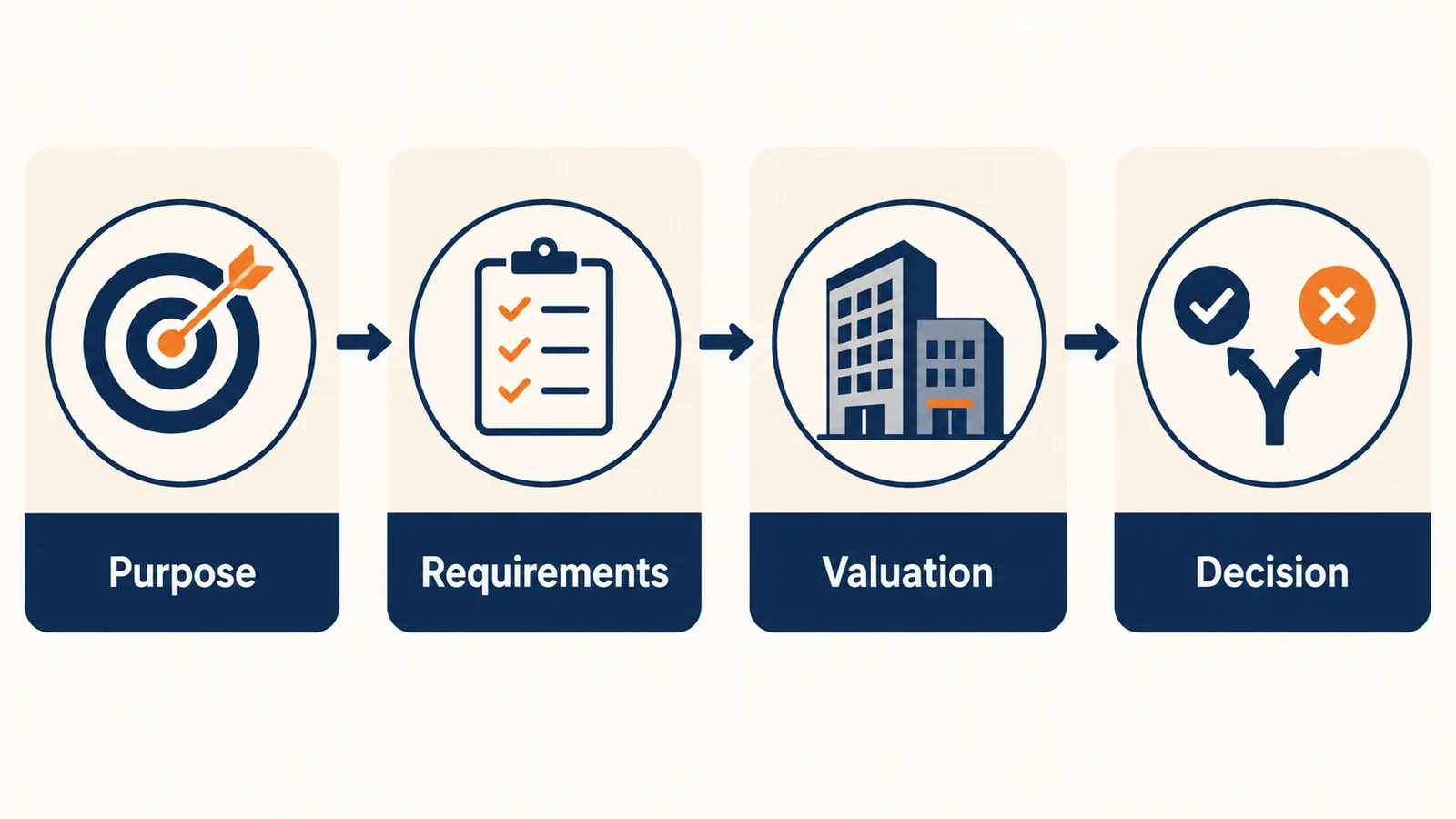
TL;DR: the finance-ready sequence
Start by identifying who will receive the report and what decision it must support. Ask that party which valuation type, basis, validation route and date it accepts. Give the valuer a complete property and income brief, agree the scope in writing, and keep the valuation date separate from the date on which the report is issued. When the report arrives, check its property identification, purpose, intended user, evidence, assumptions, value basis and uncertainty before sending it to the lender.
The amount in the report is important, yet it does not decide the loan by itself. Finance approval can also depend on affordability, loan policy, legal security, the borrower and the condition of the documents.
- Define the finance decision and intended user.
- Confirm the recipient’s acceptance requirements.
- Prepare property, lease and income evidence.
- Agree the assignment, basis and valuation date.
- Check the report against the instruction.
- Resolve gaps before submission.
Why financing changes the valuation brief
A valuation for secured lending has a defined use. The recipient needs to know what property interest is being valued, who may rely on the report, what basis of value applies and which date the conclusion refers to. RICS reporting guidance makes purpose, intended use, valuation date, basis, information sources and assumptions central to a transparent report. NRVT’s Dutch commercial-property guidance likewise covers assignment conditions, reporting requirements, reference data, plausibility checks and uncertainty.
If you are valuing a commercial property, define commercial property valuation around its use, income and physical evidence.
That is why a general request for “the value of my business property” is too vague. A lender may need a value for a particular legal interest and date, while an owner may be thinking about market positioning or a future redevelopment. Those are related questions with different evidence.
The definition page explains how property, use, income and risk fit together before the finance-specific checks begin.
Six steps to a finance-ready commercial valuation
1. Define the finance decision
Write down whether the purpose is acquisition, refinancing, a loan increase, development finance or another decision. Name the intended report recipient. If more than one party will rely on the report, say so before the instruction is accepted.
2. Confirm what the recipient accepts
Ask the lender or adviser about report type, valuation basis, maximum age, validation, inspection expectations and required attachments. These rules can differ between products and institutions. A report that is useful for one decision may need clarification or a new date for another.
Before you book an inspection, ask the lender which valuation report the lender accepts fits your application.
3. Prepare the property and income file
Send plans, title information, leases, rent schedules, operating information and relevant planning documents in one organised pack. Mark assumptions and gaps instead of presenting an estimate as if it were verified. The more complicated the property, the more useful a clear index of documents becomes.
4. Agree the scope and valuation date
Check the terms of engagement: property interest, purpose, intended users, basis of value, inspection extent, information sources, assumptions, reporting date and restrictions on use. The valuation date is not automatically the date you receive the report. Keep both dates in your finance file.
5. Check the evidence and reasoning
The report should identify the asset, explain the relevant evidence and connect the method to the property and purpose. For an income-producing asset, review lease terms, vacancy, incentives, costs and market rent assumptions. For a development or mixed-use property, check how planning, phasing and separate uses affect the reasoning.
6. Resolve gaps before submission
Compare the final report with the recipient’s checklist. Correct an address, area, legal interest, lease term or intended-user error before submission. If the lender asks a follow-up question, ask whether an addendum is sufficient or whether the assignment needs a new inspection or valuation date.
Three financing scenarios
Buying a commercial property
The buyer needs a valuation that matches the proposed acquisition and the lender’s security requirements. The asking price is evidence about the transaction, not a substitute for an independent opinion of value. Check that the report identifies the interest being acquired and the date relevant to the loan decision.
Refinancing or increasing a loan
An existing owner may have better records than a buyer, yet the report still needs current information. New leases, vacancies, alterations, planning decisions or market changes can alter the conclusion. Confirm whether the lender requires a new inspection or accepts a recent report.
Development or conversion finance
The brief may need existing value, completed value, costs, timing, permissions and assumptions about the proposed use. A value conclusion based on an unapproved plan should be labelled as an assumption rather than presented as an existing fact. Ask the recipient how it wants development risk described.
Common mistakes and how to correct them
- Requesting a generic appraisal: state the finance purpose and intended user before asking for a quote.
- Sending the asking price as the target answer: provide it as context and let the valuation brief define the question.
- Omitting lease information: send the rent schedule, terms, incentives, vacancies and relevant costs.
- Using an old report without checking the date: ask the recipient whether it is still acceptable for the current decision.
- Assuming the valuation guarantees a loan: treat it as one part of the credit and security assessment.
- Hiding missing documents: list the gap, its likely impact and the agreed next step.
- Changing the intended use after delivery: ask the valuer and recipient whether the report can be used for the new purpose.
Check the report before sending it
Use a short final check:
- Does the address, legal interest and property description match the transaction?
- Is the purpose, intended user, basis and valuation date stated clearly?
- Are the key documents and evidence identified?
- Are assumptions, limitations and material uncertainty explained?
- Does the value conclusion relate to the agreed scope?
- Has the lender confirmed acceptance of the format and date?
If the report is unclear, ask a focused question while the instruction is still fresh. Do not silently change a conclusion in your own cover email.
FAQ about commercial valuation for finance
Does a commercial valuation guarantee finance?
No. It gives the lender evidence about the property and value for a stated purpose. Affordability, security, policy, legal checks and the applicant can still determine the finance decision.
Does a lender always need a physical inspection?
The requirement depends on the lender, property and product. Ask the intended report recipient before you commission the work so that the chosen format is suitable.
Can I reuse a valuation for a different lender?
Sometimes the underlying information is useful, yet acceptance depends on the new lender, date, intended user and terms of the report. Confirm reuse before relying on it.
Which documents matter most for a rented property?
The lease, rent schedule, incentives, vacancy information, service charges and relevant operating or planning records can all affect the analysis. The valuer should tell you what is needed for the assignment.
What if the property will be converted?
Describe the current position and the proposed plan separately. Planning status, costs, timing and assumptions should be identified so the reader can see which parts are existing facts and which depend on future action.
Which tools help you prepare?
- Keep a one-page document index with the property, leases, planning, income and ownership records.
Beste Taxateur helps you organise the purpose, property information and recipient requirements before you request a commercial valuation for finance. The lender or other intended user makes the final decision about acceptance.
Ask a question about finance valuations