- Case fit
- Ask for recent work with the same property type, valuation purpose or unusual feature. A specific example is more useful than a general claim about the number of assignments.
- Recency
- Ask how recently the person handled comparable work. Rules, report formats, lender conditions and market evidence can change, so old experience needs a current check.
- Local knowledge
- Ask which local facts affect the analysis and how the person verifies them. A list of towns on a website says little unless the provider explains which local market information they use.
- Working method
- Ask how documents, inspection notes, comparable properties and assumptions are carried through into the report. A clear sequence makes gaps easier to spot.
- Independence
- Ask whether the person or firm has another role in the transaction. A valuer must be able to reach an independent opinion without pressure from a desired outcome.
- Communication
- Ask who answers questions, which language is available and how corrections are handled. You should also know whom to contact after delivery.
- Report fit
- Ask how the proposed report meets the lender, adviser, court, municipality or other recipient’s conditions. A provider’s experience with a report type only helps when that report suits your purpose.
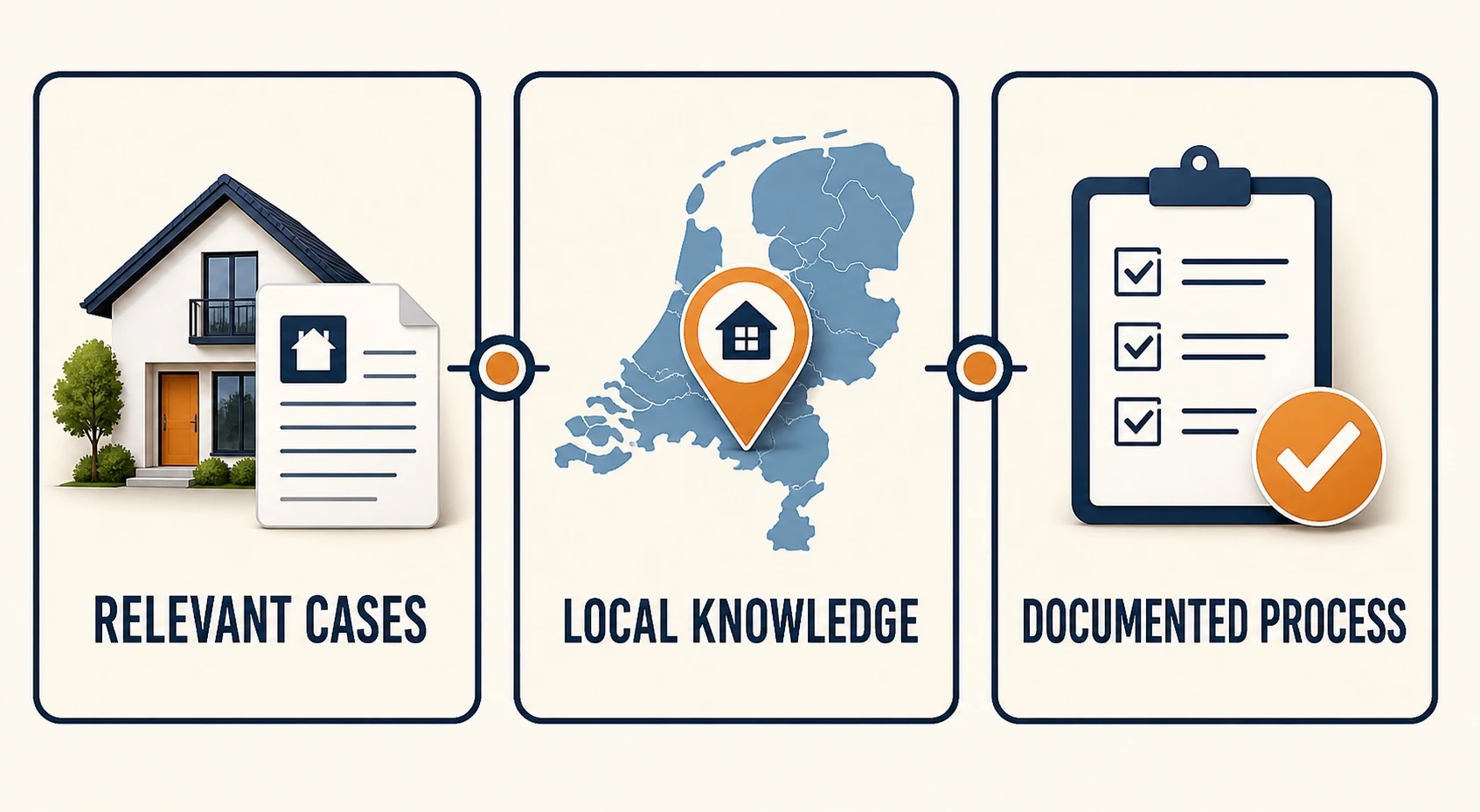
## Registration and standards are one part of the check
NRVT’s explanation of registration covers the protected RT title, the public register and the professional chambers.
Use the name of the person who will inspect and sign the report when you check it.
A registration confirms professional status. It does not show how many homes the person has valued in your municipality, whether the person handles your property type or whether a lender accepts the proposed report. That is why [checking a property valuer’s registration](/en/guides/how-to-check-a-property-valuer-registration/) is only one part of the decision.
NRVT’s [professional rules](https://www.nrvt.nl/voor-register-taxateurs/regelgeving/reglement-gedrags-en-beroepsregels/6) require a Registered Valuer to keep professional knowledge current, document the work carefully and seek help or decline an assignment when the necessary expertise is missing. They also say that a registrant in the Wonen or Bedrijfsmatig Vastgoed chamber must be able to show at least 10 compliant valuations a year in the relevant chamber. For Landelijk en Agrarisch Vastgoed, the figure is at least 5.
Those figures describe a minimum level of activity for maintaining competence. They do not promise that the person has completed assignments like yours, and they do not measure quality on their own. Ask what the recent cases involved and what the person learned from them.
Before you appoint a provider, verify [property valuer registration](/en/guides/how-to-check-a-property-valuer-registration/) when the assignment requires a registered professional.
## How to verify practical experience
### 1. Name the assignment before asking about experience
Give the provider the property type, purpose, location, report recipient and deadline. “Experience with property” is too broad to compare. “An apartment valuation for a mortgage, with a VvE and a report needed by a lender” gives the provider a concrete question to answer.
When you assess a provider’s experience, ask whether its local coverage extends to your property type and report purpose, then compare that scope with the area described for a [property valuation in Mierlo](https://taxatieeindhoven.com/property-valuation-mierlo/).
Ask whether the person who responds will inspect and sign the report. If a team member may replace that person, ask when you would be told and whether the replacement has comparable experience.
Keep the candidates manageable with a [property appraiser shortlist](/en/best-property-appraiser/how-to-build-a-property-appraiser-shortlist/) once the experience checks are complete.
### 2. Ask for comparable examples
Request two or three short, anonymised examples. Ask about the property, purpose, complication, evidence used and what the provider learned. A provider can describe the work without naming a client or sharing a confidential report.
Listen for specifics:
- Which property features changed the work?
- Which documents or records mattered?
- Which comparable properties were useful?
- What assumption needed the most care?
- What did the final report need to explain?
“We have done thousands” tells you very little about the match. A specific description of the work and the decisions involved gives you something to assess.
If you are assessing online feedback, weigh [property appraiser reviews](/en/best-property-appraiser/how-to-assess-property-appraiser-reviews/) alongside concrete information about the assignment, evidence and report.
### 3. Check whether the knowledge is recent
Ask when the most similar assignment was completed and how the provider keeps their knowledge current for your case. A long career can span several sets of rules and market conditions. Your assignment needs knowledge that fits the current requirements.
Before you speak with a provider, confirm [which valuation report a lender accepts](/en/guides/which-valuation-report-does-a-lender-accept/) so you know which questions to put to the report recipient.
### 4. Test local and object-specific knowledge
Ask the provider to name local factors that could affect the analysis. Depending on the property, those may include neighbourhood differences, building periods, leasehold terms, flood or foundation questions, apartment-owner records, access, zoning or the evidence available for a thin market.
The answer should connect a local fact to the valuation work. A list of towns does not show how that knowledge will affect the report.
When you compare proposals, include [property valuation costs](/en/guides/what-does-a-property-valuation-cost/) in the total so extra work does not come as a surprise.
### 5. Ask how experience becomes a checked report
Ask who gathers the facts, who reviews the calculations and what happens when a document is missing or a comparison is weak. A long track record still calls for a clear check of the case in front of you.
Keep the provider’s answer next to the quote.
## How the work is checked before delivery
Experience becomes useful when you can see it in a repeatable working method. Ask what happens at each stage.
### Before the appointment
- The provider records the purpose and report recipient.
- The property type and unusual features are identified.
- Required documents and access arrangements are listed.
- Possible conflicts or earlier involvement are checked.
- The scope, price, timing and correction process are clear.
### During inspection and research
- The valuer checks the property facts rather than relying on the initial request alone.
- Relevant local and market information is gathered.
- Assumptions, missing data and limitations are recorded.
- Comparisons are chosen for a stated reason.
- The person asks for specialist help when the assignment exceeds their knowledge.
### Before the report is delivered
- Calculations and conclusions are reviewed.
- The report is checked against its stated purpose.
- Supporting documents and assumptions are documented.
- You know whom to contact about questions or factual corrections.
This checklist gives you questions to ask. A firm may use different names for its internal checks or follow a different review sequence.
## Red flags and what to do next
### “We work everywhere”
Ask which recent assignments match your property and what local information will be checked. A national service area can be genuine. Ask the provider to describe the work that matches your property and location.
### “We have many years of experience”
Ask which person’s experience is meant and how much of it matches your purpose. Firm history and individual casework are separate facts.
### A company badge replaces the named professional
Ask for the full name of the inspector and report signatory.
### The provider promises a value before seeing the facts
Ask how the opinion will remain independent. A desired result agreed in advance can create pressure on the work.
### The quote does not explain corrections or extra work
Ask what happens when documents are missing, the recipient requests a change or the first report needs factual corrections.
### Reviews are the only proof offered
Ask about the method, report fit and an anonymised case as well. Reviews can tell you about communication and client experience. They cannot verify every professional requirement.
## Reviews and public proof: how much they show
### A useful review contains context
Look for the service, property or purpose, timing and a detail about the work. A review that says a report was delivered clearly can tell you about communication. It cannot confirm registration, independence or lender acceptance.
### A portfolio needs a connection to your case
Published examples can show property types, locations or purposes. Ask whether the person who did that work is the person handling your assignment. A company portfolio may combine work from several professionals.
### Public proof has limits
Privacy and professional confidentiality restrict what can be shared. A provider who protects client information can still describe an anonymised case, a redacted document structure or the checks used. The absence of a public case study gives you a question to ask. It does not prove that the work was weak.
## Questions to ask before hiring
Use this list in the same order for each provider:
1. Who will inspect the property and sign the report?
2. Which recent assignments match my property type?
3. Which recent assignments match my valuation purpose?
4. What local facts or property features will you check?
5. Which professional register or chamber applies?
6. How do you check independence before accepting the work?
7. How are documents, assumptions and comparable properties recorded?
8. Who reviews the report before delivery?
9. What is included in the price, and what can add time or cost?
10. What happens if the intended recipient asks for a correction?
Ask for short written answers when the valuation affects a mortgage, legal file or transaction deadline.
## A balanced evaluation scorecard
Use this checklist after checking that the assignment is a fit. It is a practical comparison aid, not an NRVT rating or a universal ranking.
- Named professional
- Yes when the inspector and report signatory are clear. If the answer is no, pause the comparison.
- Comparable cases
- Yes when the provider explains recent work with the same object, purpose or complication.
- Current knowledge
- Yes when the provider can explain the current report or recipient conditions that apply.
- Local or object fit
- Yes when local or specialist facts are connected to the research and comparisons.
- Documented method
- Yes when intake, inspection, research, review and corrections are explained.
- Independence
- Yes when the provider explains conflicts and can reach an opinion without pressure.
- Clear scope
- Yes when report form, price, timing, extra work and questions after delivery are stated.
Count the answers only after checking the report recipient’s requirements and the professional’s credentials. A provider with fewer public reviews may give detailed answers about the work. A large online presence may still leave the assignment fit unclear.
## Local and geographic signals
Local knowledge is useful when it changes what the valuer checks. Ask about neighbourhood differences, property ages, local construction, leasehold, apartment-owner records, planning context and the availability of comparable evidence. The right questions depend on the object and its purpose.
For another municipality, ask about the local facts that can be checked for your property. A generic service-area list tells you little. A provider who explains how local conditions affect the work gives you a better basis for comparison.
## FAQ about property valuer experience
### How many years of experience should a property valuer have?
There is no fixed number of years that proves a good fit. Ask about recent work with your property type, purpose and location, then check how the person records and reviews the assignment.
### Does NRVT registration prove experience?
Registration verifies a professional status and gives you a public record to check. It does not prove that the person has handled your exact property or that the proposed report will be accepted by every recipient.
### What does the NRVT minimum activity figure mean?
NRVT says a registrant in the Wonen or Bedrijfsmatig Vastgoed chamber must be able to show at least 10 compliant valuations per year in the relevant chamber. The figure relates to professional competence maintenance. It does not describe ten cases like yours or act as a quality score.
### Can a new valuer be a good fit?
Yes. A newer valuer can still be suitable if they can show the required status, relevant supervision or support, a clear method and a report that fits the assignment. Ask what work they have completed and who reviews it.
### How can I check experience without requesting private reports?
Ask for anonymised examples of comparable assignments, a redacted report structure, a description of the checks and a clear explanation of the property features that mattered. Client names and confidential documents should remain private.
### Does local experience matter for every valuation?
It matters most when local property types, planning, leasehold, market depth or municipal information affect the work. Ask the provider to connect local knowledge to the evidence used.
### Are reviews a reliable way to choose a valuer?
Reviews can help you assess communication and the client experience. Check registration, case fit, independence, report method and recipient requirements separately.
### What if the report is rejected?
Ask the report recipient which condition was missing and ask the provider how corrections are handled.
## Document your evidence and next steps
Keep a short record of the property, purpose, report recipient and deadline. Add the professional’s name, the date you checked the register, the answers about comparable cases, local factors, scope, price, timing and corrections. Note any limits the provider mentioned.
Use the official links and your notes together. They give you a decision record you can revisit when you compare providers or explain your choice to a lender, adviser, solicitor or co-owner.
## Final trust checklist
Before you appoint a property valuer, confirm:
- [ ] I know who will inspect and sign the report.
- [ ] I checked the person’s registration when the assignment requires it.
- [ ] I heard examples of recent assignments that match my property or purpose.
- [ ] I understand which local or specialist facts will be checked.
- [ ] I know how documents, assumptions and comparable properties are reviewed.
- [ ] I asked about independence and earlier involvement.
- [ ] I confirmed the report recipient’s conditions.
- [ ] I have the price, timing, extra-work and correction terms in writing.
- [ ] I recorded the date of my checks.
This gives you more to compare than a label such as “experienced”. It also leaves a clear record of why you chose the provider if a lender, adviser, solicitor or co-owner later asks.